Showing posts with label Low maintenance plants. Show all posts

Sunday, August 24, 2014

Crassula ovata aka Money Tree or Jade Tree. One of the easiest pot plants to grow.

Crassula ovata

Without a doubt Crassula ovata is one of the hardiest and neglect tolerant plants I have grown to date. It has a few different common names 'Money Tree' being the most common. The problem with common names is the confusion that arises when different plants are given the same common name and Crassula ovata is one such plant. I have found that people often give all Crassula's the moniker 'Money Tree' especially the smaller leafed Crassula (I'm unsure of the botanical name). The great thing about this plant is that it is almost a 'pot and forget' plant. Being a succulent it requires very little water in the summer and even less in the winter. It is also almost fail proof in terms of its strike rate when propagating it from cuttings which can be either stem or leaf cuttings. It flowers in winter and can be planted outside in the ground or potted up and placed either inside or outside. The only trouble I have had with my potted Crassula is frost damage which occurred when I moved the plant from its original position where it was protected by my verandah. Crassula ovata is originally native to South Africa but is now found many countries. It is often used as a Bonsai plant. Crassula ovata is a great plant to gift somebody who desires a low maintenance plant. 


This Crassula was located in a car park in Brunswick Victoria. This attests to its hardiness as it would have to endure all sorts of damage in that location.


A close up of a tiny white / pink flower cluster.


As with many other succulents the appeal is mostly in the foliage. 


This is what heavy frost will do to a Crassula. This poor fellow is from my home and it had to endure not only heavy frost but also snow this winter. If I had kept it under the cover of the verandah it would have been fine. I'm predicting it will bounce back once the weather warms up.

Sunday, June 29, 2014

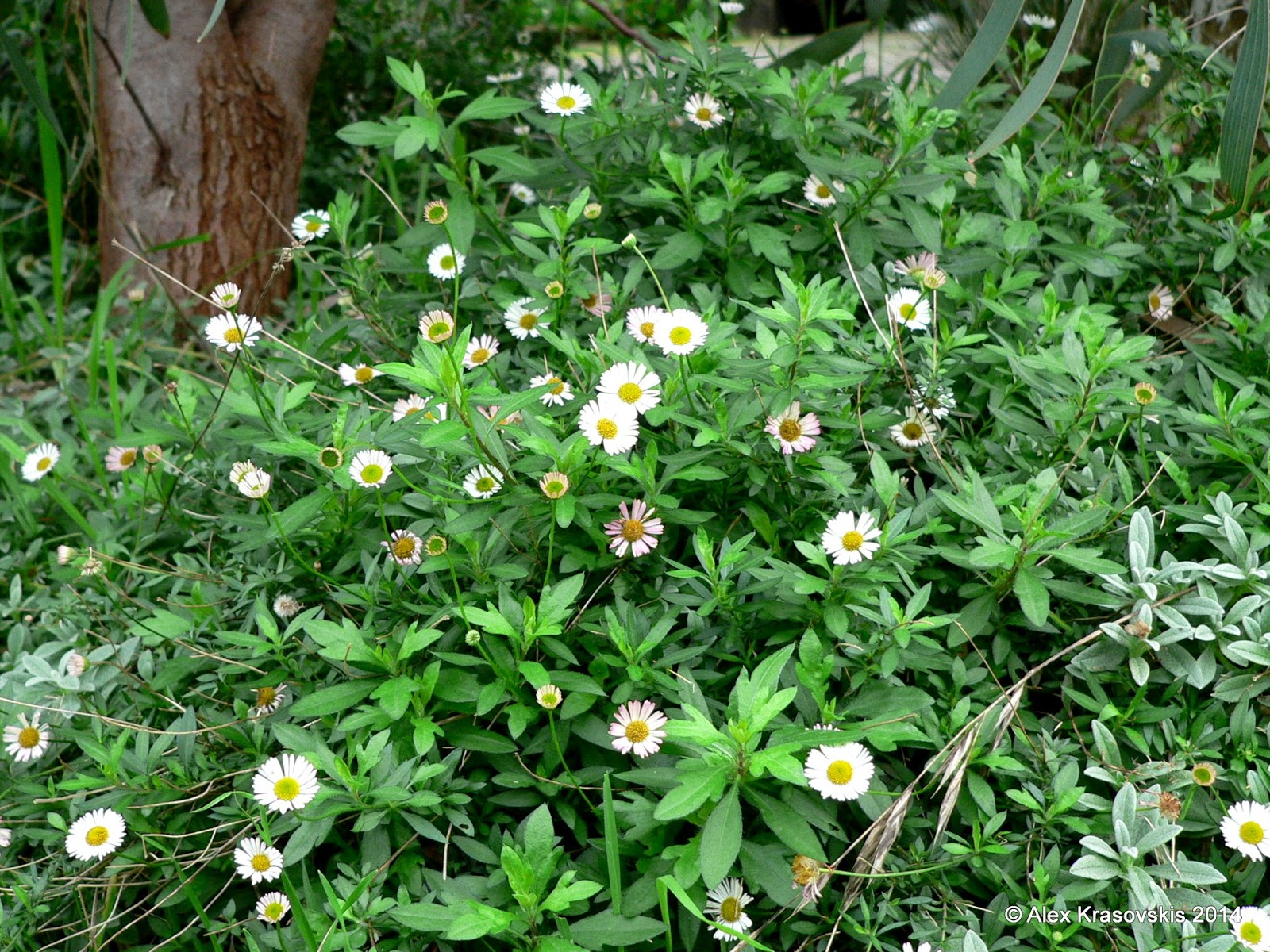
Erigeron Karvinskianus aka Seaside Daisy. A classic ground cover plant.

Erigeron Karvinskianus (Seaside Daisy)

I was recently doing a job overhauling a clients front yard and needed a ground cover plant to fill a space. The plant needed to be able to tolerate some shade, tough, a relatively low water user and a prolific spreader with the ability to out-compete any weeds that might pop up. A mass planting of Erigerons immediately came to mind.

Erigerons have been a staple plant of many cottage gardens in Melbourne for as long as I can remember. They are a plant I had trouble formally identifying. When I asked people what they were called people just shrugged there shoulders and said things like 'I don't know... That daisy plant'. They are unassuming and common but don't let that deter you. Erigerons are a tough little blighter of a plant able to tolerate dryness, shade and general neglect. I have them in my own garden in Macedon where they have proven to be very frost hardy. I have never watered them and they still thrive. Another great thing about seaside daisy plants is how they seem to constantly have at least some their tiny white / pink flowers on show in the cooler months were they are at their low ebb.

Seaside daisy spacing for use as a ground cover

Information on the plant tags for Erigerons usually states a width of about 1 metre. When I planted out my clients garden with them I spaced them at 40cm to ensure a fast meshing of their foliage. I had improved the soil in which they reside so I wanted fast coverage on that area so weeds couldn't take hold. Seaside daisies will self seed and spread around a bit so you could probably get away with planting them a little further apart if  need be. 


The classic daisy flower of Erigeron Karvinskianus


 Here they are having no trouble covering the soil under an established Hakea tree in my garden in Macedon. Keep in mind this picture was taken in winter and they are usually described as being a warm season flowering plant.


Saturday, August 17, 2013

Euphorbia characias subsp. wulfenii. An extremely tough and drought tolerant plant for Australian conditions.

Whoever owned my house before I bought it decided to put a garden bed right under the eaves outside my bedroom. This is a bit of a classic mistake as the cover of the eaves provides a rain shadow. Essentially no rain will fall on the portion of the garden bed under the eaves creating desert like conditions. I tried planting plants there and watering them with my trusty watering can but I would inevitably let the area dry out too much and they would die. Then somebody recommended that I try planting Euphorbia characias subsp. wulfenii there and I haven't looked back. The Euphorbia genus may be more well known as a weed to some (and this particular plant is restricted in W.A and the N.T)  rather than an ornamental plant but that weedy robustness is what makes the charcias species such a great plant. The soil under my eaves where this plant is growing is really sandy and dry. I do still water this plant but only once every couple of weeks and it would only get 10 litres at a time if it is lucky. Despite that lack of water and poor soil it has thrived and I would highly recommend it as a drought hardy perennial plant for people in Melbourne or even up in the central highlands of Victoria. It is said that it needs full sun but mine is planted on a Western aspect so it can deal with part shade. Although it is said to be a perennial it does get quite leggy after a few years but I have found that it self seeds quite well so there is always some new plants on the rise. Euphorbia characias is native to the Mediterranean and its milky latex sap has been used as an ancient traditional plant medicine to treat skin issues such as warts, skin cancers and tumors. The latex sap however is to be treated with caution. If you get it in your eyes it can cause significant damage. Do not ingest any part of this plant as it is toxic. There are several different cultivars that are in nurseries so if you are in the market for a low maintenance, drought tolerant plant (and don't live in W.A or N.T) then give it a go.


A close up (and slightly out of focus) shot of the flowers.


Euphorbia characias in full bloom during winter.


I find the foliage of Euphorbia characias more interesting than its flowers. The 'Black Pearl' cultivar has foliage the same shape as the one pictured below but with dark and almost black leaves. 


Wednesday, May 8, 2013

Classic common house plant Aspidistra aka cast iron plant

A very common and useful house plant is the Aspidistra or cast iron plant. I remember as a youngster people telling me that this plant will grow in a dark hallway of a house and indeed it does. I have owned a couple of Aspidistras over the years and even managed to keep some alive as a young man in my early twenties. That was possible because Aspidistras are very tough and could endure my lack of care. They seem to thrive on neglect and infrequent watering. The only thing they don't like is lots of sun so if you buy one don't put it in front of a window at home or it will bleach out and die. They are native to Japan and I'm fairly sure that the species that I have pictured here is Aspidistra elatior. It was previously thought that Aspidistras were pollinated by snails and slugs. We now know this isn't true and they are in fact pollinated by tiny crustaceans and amphipods. Some are also now saying that fungus gnats may be a pollinator but research is not conclusive at the present time. Another interesting fact is that the foliage of some Aspidistra plants was originally used in Japanese sushi boxes to separate the food but now imitation Aspiditra leaves are used. I would recommend this plant to anybody who wants an extremely low maintenance, tough and low light indoor house plant.

Friday, April 19, 2013

Nephrolepis cordifolia or Fishbone fern an Australian native plant

Botanical name: Nephrolepis cordifolia
Common names: Fishbone fern, herringbone fern, narrow sword fern, tuber ladder fern and erect sword fern
Native to: Australia and some parts of Asia


In my family Nephrolepis cordifolia is a divisive plant. This is because my father planted them in almost every family house garden he owned over the years. It was almost like that was the only plant he could be bothered with. I think because I've seen so many of them over the years they look boring to me but beauty is in the eye of the beholder and I know lots of people like these plants.

Nephrolepis cordifolia has been introduced to several countries including the USA, New Zealand, French Polynesia and Bermuda. In New Zealand and Florida USA it has been declared a noxious weed due to its invasive tendencies in those areas. I suppose you are always going to run that risk if you introduce tuberous plants to areas where they do not originate from.

Fishbone ferns are native to Australia, particularly Northern Australia. That being the case you wouldn't think they would grow down South in Melbourne but they do. They are often used to line driveways, encircle trees or to line the base of a house. They are very tough drought tolerant plants. I would describe them as a low maintenance plant because of their low water needs and the fact they don't really need any pruning. The only pruning you might do on a Fishbone fern is to cut out any old dead fronds or to completely cut them down to start them off again. They can be frost tender but in places like Melbourne they are fine. They can grow to 1 metre high and spread 1 metre. They like well drained soil and full sun but will tolerate some shade. I would recommend this plant to anyone in Australia who needs a fairly low growing plant which basically needs no watering and no maintenance.