Showing posts with label Australian natives. Show all posts

Sunday, April 3, 2016

Melbourne International Flower & Garden Show 2016 garden designs

MIFGS 2016 

Recently in Melbourne the annual flower and garden show was in full swing in the Carlton gardens and as usual I paid a visit with camera in hand to try and capture some of the amazing designs on display. As usual everything was of high standard with a few of the designs really impressing me. Aside from the garden designs the garden sculpture/art section of the show was also impressive with more timber being used in the pieces submitted. I've covered the show several times before in my blog and this time rather than waffle on about this and that I've decided to jump right in with the pictures which I'm guessing is what everyone really want to see.


Ian Barker garden design

A regular at the show Ian Barker and his team put together this wonderful display which made use of an existing pond in the Carlton Gardens. To my eye the design appeared to be a mixture between sharp / formal lines broken up by the use of herbaceous perennials and a gravel path. Obviously it also incorporated a small boat ramp. Polygonum, Helenium, Salvia, Geum, Verbascum and Panicum were some of many species used.


'The Greenery Garden' by the Greenery Garden Centre. Gold Medal Winner

The Greenery Garden Centre is an establishment in Melbourne's northern suburbs famous for its large range of high quality plants. It isn't the cheapest nursery in Melbourne but the stock is always of good quality. What there design name lacked in terms of creativity was certainly made up for in terms of plant layout and selection. The hard architectural elements of the design were also fantastic with several sections visually separated from each other. This made the design somehow seem larger than it was in its entirety. The shiny dark green foliage of the background plantings highlighted the light coloured flowers in the display. They used time proven classics such as Hydrangeas, Cistus, English box and Magnolia 'little gem'.


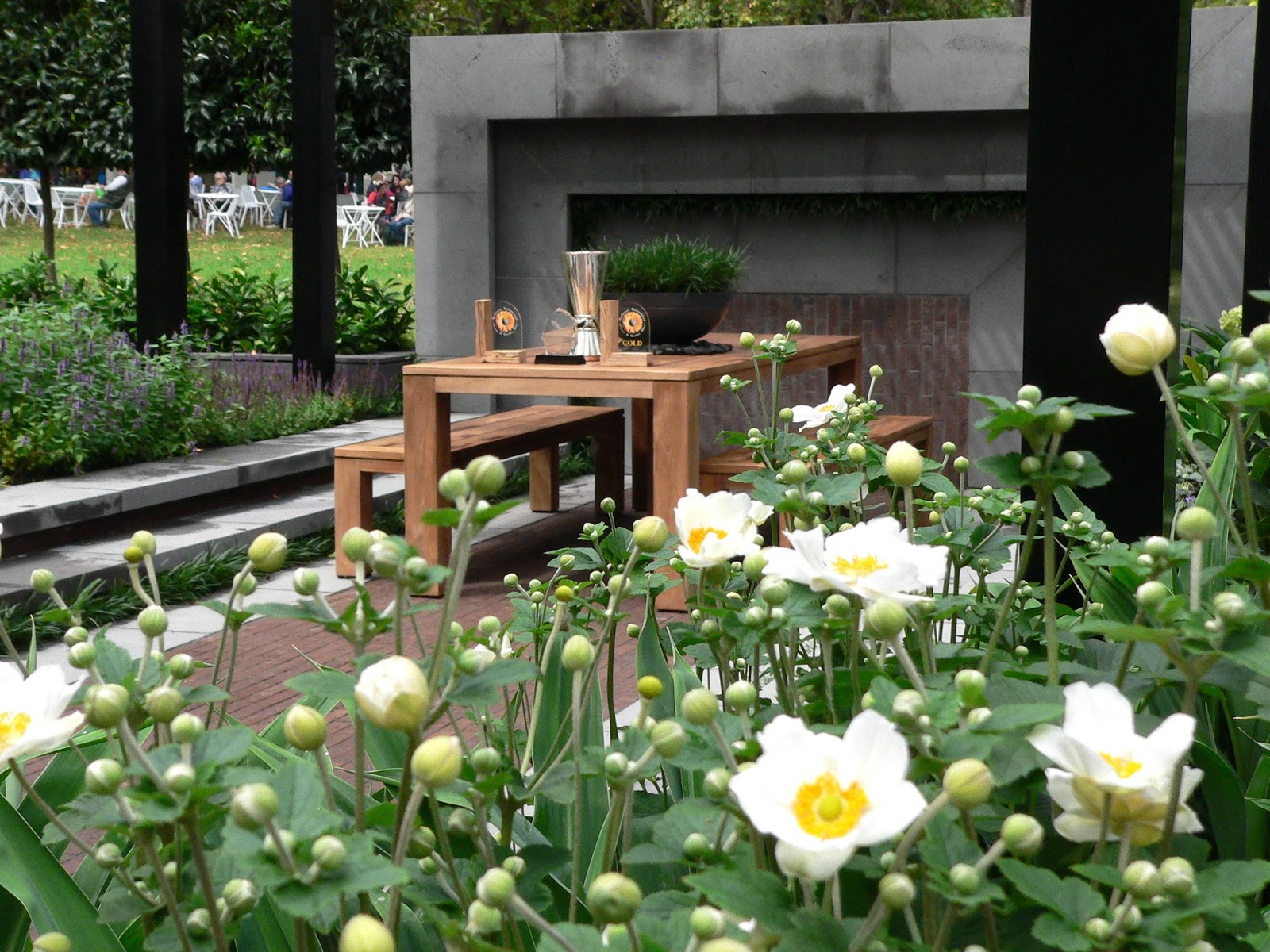


'Absendere' by Landscabe Labs. Bronze medal winner

This minimalist design won the bronze. Not really my cup of tea but obviously the judges thought otherwise. It seemed to incorporate more turf and architecture than it did bedding plants and trees. In the beds I think I saw some Sedum, Lomandra and maybe some young Proteas.


GHLD & The Garden Co. Silver medal winner.


This rather tropical looking design was good enough for a silver. One of its main tactics was the usage of large foliage. Ancient Cycads, palms, Agaves, Cannas, Strelitzias and Fragipanis were all used.  The surfer girl in the water feature was a focal point but I'm not sure if many people would appreciate that in their home garden.


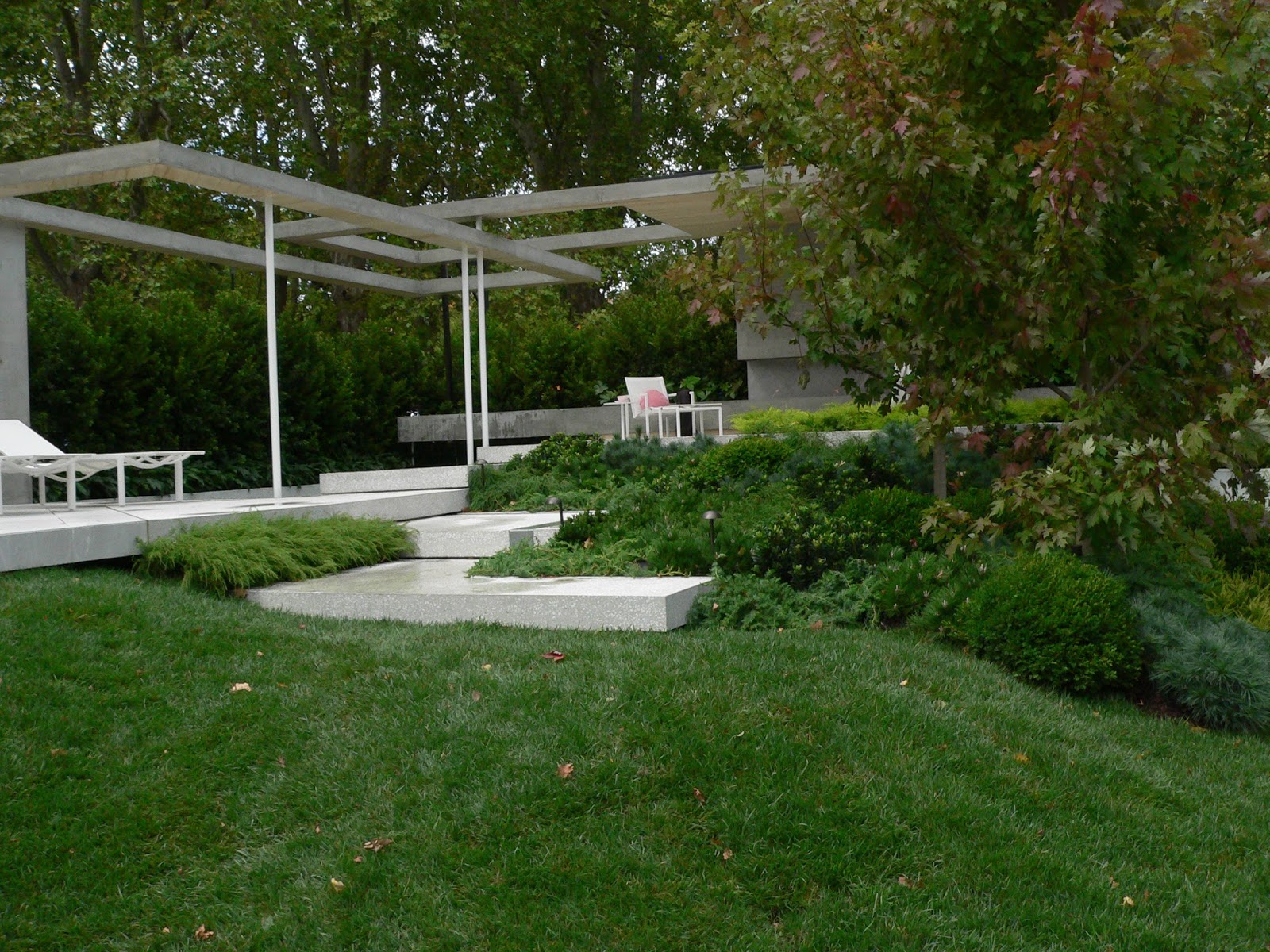
BLAC Design and Contruction. Gold medal winner


This very subtle design took out a gold medal. It was a bit an out of the box type of design with not a flower in sight. It was basically a mixture of different green foliage with a few grey / blue plants and some really light almost lime green plants in there to help keep things interesting. I can't really tell from my pictures but lots of the plants in the bed look to be prostrate gymnosperms or conifers to the layperson. There also appears to be several grass plants in there too.


The Aggregata Plants & Gardens blog personal choice award goes to................

'The Retreat' by Paul Hervey-Brookes

Not all the plants used in this design were Australian natives but 'The Retreat' unmistakeably had an Australian aura. This design showcased what I would describe as a wilderness garden come colonial settlers cottage style of garden. It used several Eucalypts for the tall plants and had several beds which bordered a meandering path of granetic sand and river pebbles. Westringia, Anigozanthos, Limonium, Correa and Salvia (I think) were used in the beds. The colour of the sand and the river pebbles seemed to simulate a dry river bed you might find somewhere where the soil has a tinge of redness to it (like parts of the snowy mountains). This splendour was all complimented by a traditional rusty gate.


Garden art and sculpture

I have recently been doing some work for a company called 'Neo Rustic' which sells different Australian  and exotic hardwoods and makes benches, tables and furniture from timber. Maybe that is why I seemed to notice an increase in the amount of timber used in the garden sculpture at MIFGS. I really love the use of timber in garden sculpture as I think it has a much more organic appearance compared to straight stone or metal pieces. Lots of the timber seemed to be Tasmanian in origin (eg Huon Pine).


Thursday, January 22, 2015

Plants along the 'Two Bays Bushwalk' from Dromana to Cape Schanck

Two Bays Walking Track 2014

In late December 2014 I was visiting the Monington Peninsula and decided to attempt what is known as the Two Bays walking track. The track is a respectable 26km long and starts in Dromana in the area known as Arthurs seat and ends at the lighthouse in Cape Schanck.

Indigenous plant hunt along the Two Bays Bushwalk


A few days before I trekked the Two Bays walk I had just finished a book about Charles Darwin and the other prominent British naturalists of the 19th century. The tales of botany in that book inspired me to try and locate and identify some indigenous plants. All in all I managed to identify and photograph many more than I expected. I must say that if you are a bit of a plant nerd like me that trying to identify indigenous plants along a walk makes it much more interested and rewarding. It's amazing how being able to identify native plants really opens your eyes as to the diversity of plants in the bushland.

A Xanthorrhoea heaven on earth


The most impressive plants on show along the track were the monstrous Xanthorrhea australis grass trees. These trees grow at an extremely slow rate. The annual vertical growth rate is reputed to rarely be greater than 2cm. Some of the plants along the walk were over 2m tall with flower spikes reaching well over 3m tall. These grass trees are very expensive to buy in nurseries as they are listed as vulnerable plants and as such it is illegal to take them from the wild. Although they are listed as vulnerable you wouldn't know it from the huge number on show along the Two Bays track. I was pleasantly surprised as I never expected that there would be so many densely packed into this area. They were growing so densely that on certain sections of the track they were hedged to as their foliage was blocking the path.

The walk itself


In retrospect my biggest mistake was not bringing any band aids with me. For the first 19km I was fine but the last 7km wasn't so comfortable as a couple of blisters had formed on my feet. I'm not the fittest person on earth but I wouldn't describe myself as unfit either so If you think of yourself in the same way the walk should be within your capabilities. The walk took me 7 hours to complete and apart from my aching feet I felt fine. If you want to attempt this walk yourself maybe try some smaller walks to begin with if you are unsure, take plenty of water and check the bushfire rating if it is summer.

Below are a series of pictures I took along the way of some indigenous plants and other niceties.


This is the view from the Arthurs Seat section of the walk overlooking Dromana. This section was quite steep but after the the walk was fairly flat and mostly downhill.


Messmate trees form the canopy for large parts of the track near Arthurs Seat.


The first indigenous plant I found was this Goodenia ovata common name hop goodenia


This plant is called Dipodium roseum (common name pink hyacinth orchid). It was easy to spot as its bright pink flowers stood out amongst all the green of the bushland.


These next 2 photographs turned out great. They are flowers of the coastal banskia tree Banksia integrifolia.


The spent flowerheads of the coastal banksia.


The plant below is definately not indigenous. It is called boneseed and is a noxious weed. Signage in this area said the weed was such a problem that they have start trialing biological controls to try and eradicate it.


Not all the track is in the bushland. This vineyard is typical of many in the area which is known for producing superb white wine.


This next group of pictures shows Xanthorrheoa australis plants along the section the track south of gardens road.


The track is clearly marked with the fairy wren logo and direction arrows.


Speaking of fairy wrens I managed to snap this one. There are lots of them in the area.


This photo was taken deep in the Greens Bush section of the walk. In 1975 the state government purchased 500 hectares of bushland from the Greens family with the view of protecting it from development or farming. The Greens Bush section is the most untouched section of the walk. Lots of grass trees were growing here and you are surrounded by only the sights and sounds of the bush.


Xanthorrhoeas in the Greens Bush section.


After leaving Greens Bush the trees start to be dominated by coastal banksias as shown below.


Below is some sort of Leptospermum (common name tea tree). I had trouble trying to identify the exact species of the tee tree as there are many that look similar but I couldn't find one that looked exactly like the ones I found.


This little plant was everywhere on the section of track close to Cape Schanck. It is called Chenopodium candolleanum (common name seaberry saltbush). Apparently the leaves can be cooked and eaten.


This pristine section of beach is called Bushranger's Bay. It looked to have some small / medium waves and nice clear water. Definitely on my hit list for the next visit.


A tunnel of tea trees along the last 4km of the walk.


The Cape Schanck lighthouse was sight for sore eyes (or more accurately sore feet). If you've made it this far you have completed the whole 26km.


The boardwalk and rocky coastal section at Cape Schanck.


The indigenous plant below is Leucophyta brownii or the cushion bush.


I made it to the ocean. Below is a view from the sand on the beach below the Cape Shanck boardwalk.


The foliage of Disphyma crassifolium or noon flower was found on the banks along the Cape Schank boardwalk area.


Alas this was the only noon flower I found on the plant. If only I had been there a month or so earlier.


Last of all a picture of the Melaleuca sp.