Showing posts with label Bluebells. Show all posts

Wednesday, September 24, 2014

Add some blue to your late winter / early spring garden with Spanish bluebells

Hyacinthoides hispanica (Spanish bluebells)

Around this time of the year a nearby town called Kyneton hosts a daffodil festival. The cooler climate that the area provides really suits daffodils and as such lots of people have them growing in their gardens. That being the case another bulbous plant commonly known as the bluebell has to take a back seat to the Narcissus plants.  It flowers at the same time as daffodils and jonquils and planted in mass is quite spectacular.

Hyacinthoides hispanica or Spanish bluebells are native to an area known as the Iberian Peninsula which as expected contains the Spanish coastline and other nearby regions. They are dead easy to grow and as with many other bulbs they are extremely hardy specimens. I have seen them growing in extremely dry locations such as under an archway where almost no rain would fall. In England they have hybridized with Hycacinthoides non-scripta and the resulting plant is quite invasive. In Melbourne this isn't the case and they are a great addition to your other bulbous plants.

After they finish up for the year let them die back and try to resist cutting back the browning foliage. If you leave the foliage to die back the bulbs will benefit and draw energy from the leaves. This energy will assist in the next years bloom. If left in place they will naturally propagate themselves and you should get more and more each year. If you get too many simply dig up some of the unwanted bulbs.


Saturday, December 14, 2013

Visit to the historical gardens of Duneira in Mt Macedon

During the last month of spring the gardens of Duneira in Mt Macedon were open for viewing. Even though it was the end of spring the weather on that day was particularly poor. So poor that I contemplated not going at all. In the end I motivated myself enough to make the trip and I'm glad I did. When I arrived the rain stopped and although the temperature was still a little mild the garden was empty of all other visitors. It almost felt as though I was intruding.

Duneira is one of Mt Macedon's most well known gardens. It's size is impressive with 25 acres of parkland surrounding the main central garden. Its original designer is unknown and the property itself has had 7 owners throughout its history. The last owner was Stuart Stoneman who, after his passing, bequeathed the care of Duneira to the Stoneman Foundation so the property is not personally owned as such.

The things I loved most about Duneira were the impressive driveway lined with elm trees and bluebells, the open parkland areas with established exotic trees and most of all the garden rooms lined by hedges. Judging from the size of most of the trees I'm guessing Duneira was left mostly unscathed by the 'Ash Wednesday' fires that swept through the mountain. I'm looking forward in visiting again in autumn to see what this amazing garden looks like in a different season.


View of the massive driveway which is lined with Dutch elms.  Due to the demise of so many elms overseas because of the elm beetle this sort of view is becoming quite rare.


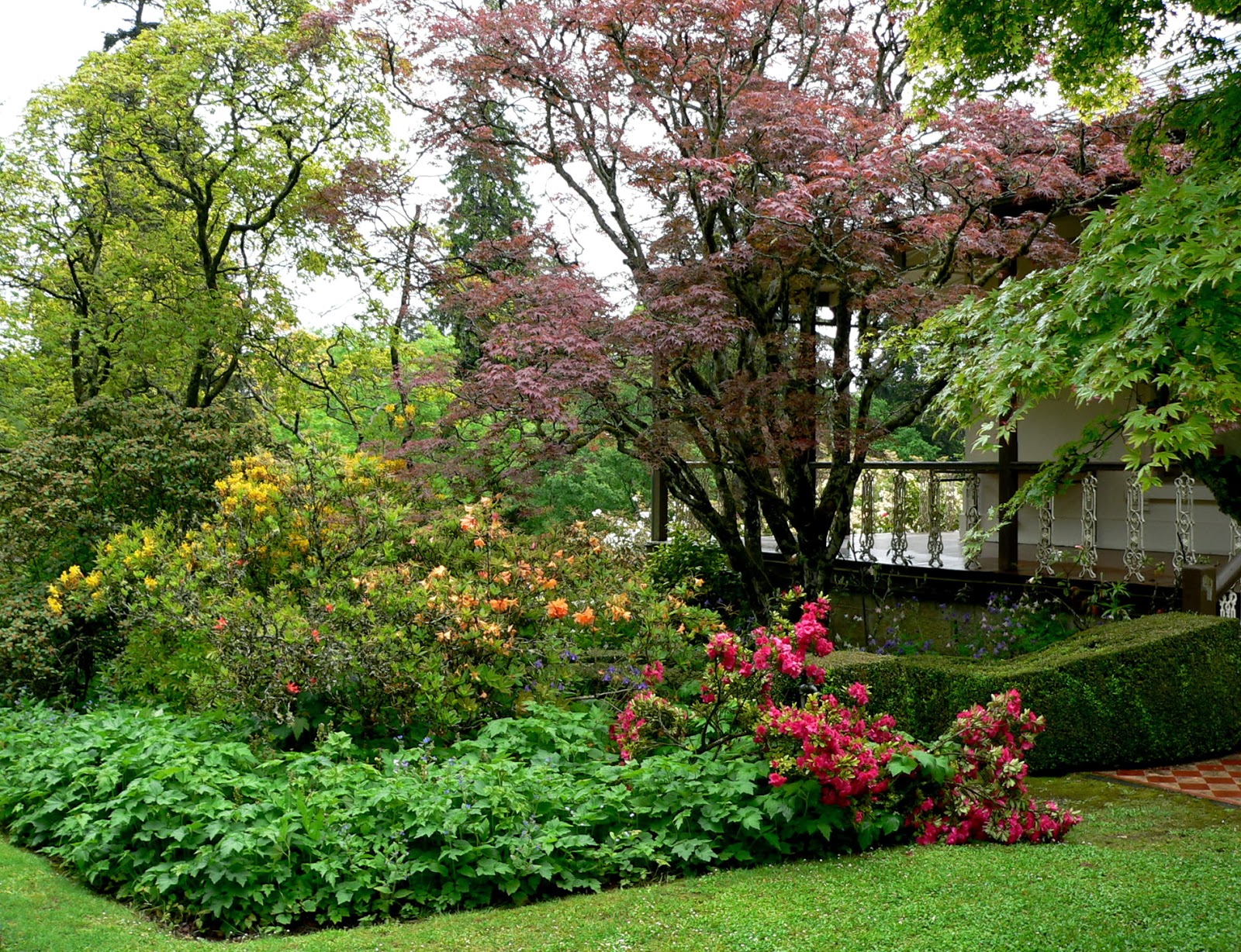
Rhododendrons thrive in the naturally acidic soil and cooler climate of Mt Macedon. Duneira has some absolutely amazing specimens.


There were a few pieces of sculpture throughout the garden such as this lions head.


Unfortunately when I visited the bluebells were all finished for the year. They must look absolutely increadible when in flower because there were so many of them


More huge Rhododendrons.


A view from inside the Rhododendron cluster pictured above.


Hostas are in all the big gardens on the mountain that I have visited. They love the cooler climate.


These next 6 pictures are of the garden rooms lined with hedges. I think they refer to this part of Duneira as the 'secret garden'. It was my favorite part of the property.


I small view of the house itself which is not a huge house compared to the overall size of the property.


Along with the hostas, box hedge is also a common plant on the mountain.


A view of the main lawn outside the front of the house. I went to Christmas carols here last year. 


Foxgloves


These red berries belong to a tree called Himalayan holly.


The next 2 pictures are of a variegated sycamore tree.


Aquilegias were throughout the garden


A weeping elm tree.


Japanese maples


A manicured variegated holly bush.


A view of the orchard towards the back of the property.


Thursday, September 26, 2013

Parkville garden spring update

As the saying goes 'spring has finally sprung' in Melbourne and the garden I work in at Parkville is showing signs of new growth everywhere. It is so nice to be working outside with the sun shining on my back. We have had some fairly serious spring weather of late including winds that ripped through the garden at over 100km per hour! There has also been a few days where we experienced really heavy rainfall. Despite the weather the garden is still looking chirpy with new growth popping up everywhere and in another month or so it should start to look its best with most of the warm weather plants in bloom or just starting to pop open. My current favorite garden bed (the annual bed) is finally showing all of the flowers on the plants I planted there in winter. I have sown seeds including giant Hollyhocks and Zinnias in tubes ready to restock the annual bed for later in the year. I will post another update on the Parkville garden in a month or two when everything is firing at its peak.


The annual bed as it was a couple of months ago


 The annual bed as it is now. This time I planted Kale, Pansies, Violas, Cinerarias and Stocks


These Cinerarias look so much more blue in real life than in these photos. They were at their best about a week ago and are now starting to show some signs of old age.


These next two pictures are of the beds at the entrance. The Echium simplex flowers are almost all open. Also visible in the first picture is are some tree Euphorbias (Euphorbia lambii). In the second shot you can see the Hellebore flowers are still hanging on for dear life in the warm weather and behind them is a Salvia leucantha bush we pruned in the winter.


Below is a plant called a Sonchus (not sure of the species). Before this plant flowered I thought it was quite boring but now it has opened it sure is a head turner. It reminds me of a giant dandelion and is nudging 2 metres in height.


We have lots of bluebells in various locations in the gardens and they are all open at the moment.


One of the classic Melbourne plants, an Azalea.


This spring the Clivias are putting on a much better show than last year. They must have just the right conditions.


I really like this last plant. It is an Alyogyne which believe it or not is a plant indigenous to Australia. I occasionally  come across plants such as this that seem to look anything but Australian and it surprises me. I love the huge purple flowers.