Showing posts with label Parkville. Show all posts

Thursday, September 26, 2013

Parkville garden spring update

As the saying goes 'spring has finally sprung' in Melbourne and the garden I work in at Parkville is showing signs of new growth everywhere. It is so nice to be working outside with the sun shining on my back. We have had some fairly serious spring weather of late including winds that ripped through the garden at over 100km per hour! There has also been a few days where we experienced really heavy rainfall. Despite the weather the garden is still looking chirpy with new growth popping up everywhere and in another month or so it should start to look its best with most of the warm weather plants in bloom or just starting to pop open. My current favorite garden bed (the annual bed) is finally showing all of the flowers on the plants I planted there in winter. I have sown seeds including giant Hollyhocks and Zinnias in tubes ready to restock the annual bed for later in the year. I will post another update on the Parkville garden in a month or two when everything is firing at its peak.


The annual bed as it was a couple of months ago


 The annual bed as it is now. This time I planted Kale, Pansies, Violas, Cinerarias and Stocks


These Cinerarias look so much more blue in real life than in these photos. They were at their best about a week ago and are now starting to show some signs of old age.


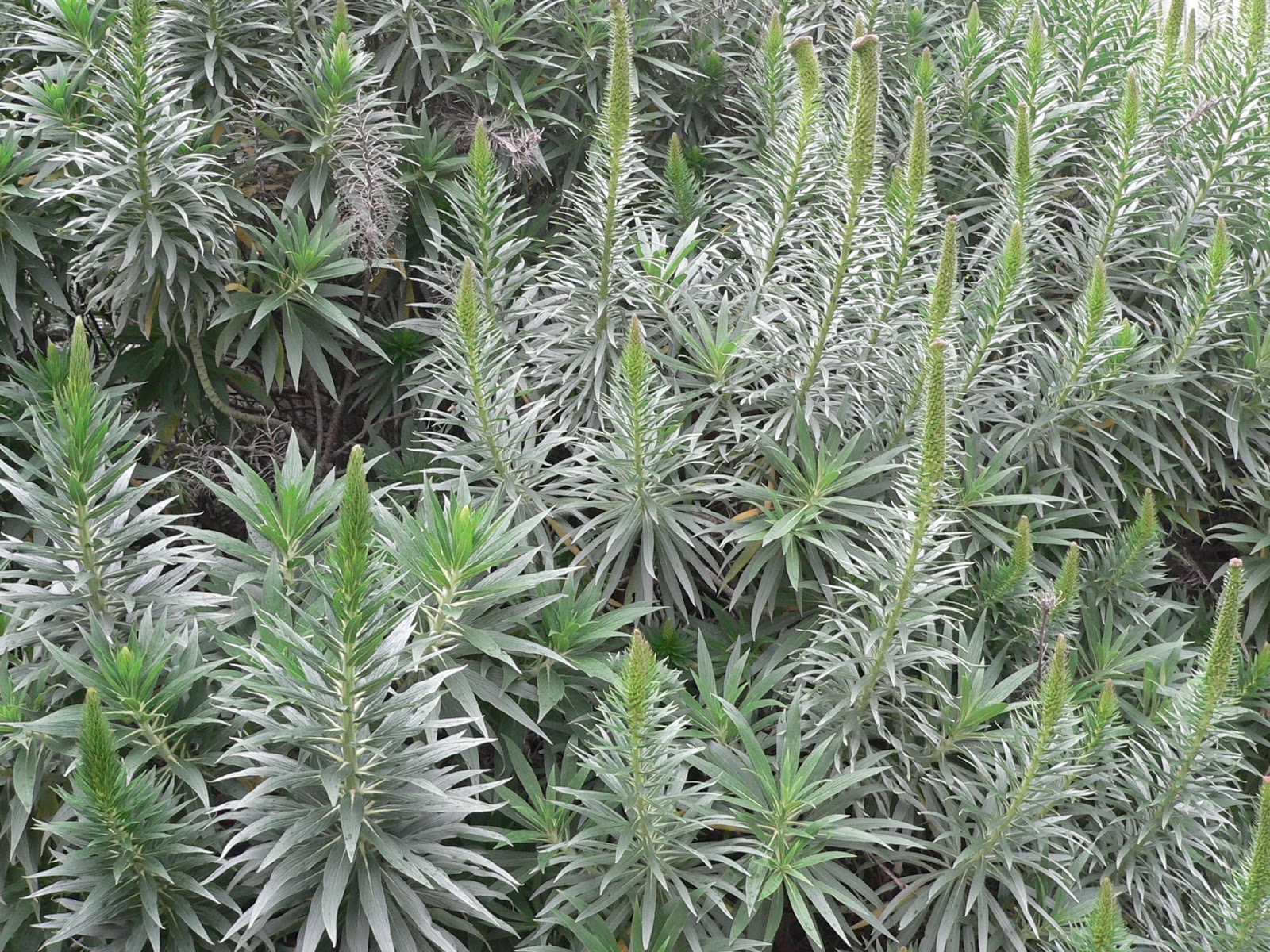
These next two pictures are of the beds at the entrance. The Echium simplex flowers are almost all open. Also visible in the first picture is are some tree Euphorbias (Euphorbia lambii). In the second shot you can see the Hellebore flowers are still hanging on for dear life in the warm weather and behind them is a Salvia leucantha bush we pruned in the winter.


Below is a plant called a Sonchus (not sure of the species). Before this plant flowered I thought it was quite boring but now it has opened it sure is a head turner. It reminds me of a giant dandelion and is nudging 2 metres in height.


We have lots of bluebells in various locations in the gardens and they are all open at the moment.


One of the classic Melbourne plants, an Azalea.


This spring the Clivias are putting on a much better show than last year. They must have just the right conditions.


I really like this last plant. It is an Alyogyne which believe it or not is a plant indigenous to Australia. I occasionally  come across plants such as this that seem to look anything but Australian and it surprises me. I love the huge purple flowers. 


Friday, September 6, 2013

Euphorbia lambii also known as the Tree Euphorbia. Another tough and low water use specimen

 Euphorbia lambii aka Tree Euphorbia


I first saw Euphorbia lambii when I started working in my current job working in a huge garden in Parkville. When I first laid eyes on it I was immediately struck by the magnificent symmetrical architecture of its branches. The appearance of this plant really quite individual and I'm not sure why but I have always thought of it as looking somewhat prehistoric. The cultural notes for this plant are basically identical to Euphorbia characias which I have written a previous entry on (see http://aggregata.blogspot.com.au/2013/08/euphorbia-characias-subsp-wulfenii.html). This tree only grows to about 2m in height with a spread of roughly 1-1.5m. It flowers in late winter through to the end of spring. Due to its weedy toughness and ability to self seed quarantine restricts its sale to W.A and N.T in Australia. In other countries with similar climates I believe it is also classified as a weed so please check before planting it.

Toxicity of Euphorbias

 That last entry I wrote about Euphorbia characias was a bit controversial with some readers due to the fact that it is actually a weed in some places but someone was also concerned about the potential toxic affects of the milky Euphorbia sap. I feel obligated to state that you shouldn't eat this plant (I don't know why anyone would) as its sap is toxic. The sap itself can also cause irritation to the skin if contact is made but oddly the sap is also used as a traditional medicine against various skin issues. Do not get the sap in your eyes. A woman at my place of study got Euphorbia sap in her eye and had to get her eyes flushed with water.

Close up of Euphorbia lambii's lime green flowers


This particular specimen is at full size. They don't really get much larger than this (in my neck of the woods at least)


The dividing branch structure of this plant is what makes it look so unusual. 


Friday, July 19, 2013

Winter flowering plants in Parkville

It's a common misconception that plants do not flower in winter. In Melbourne this is definitely not the case and I am a great believer in winter flowering plants they provide attractive colour  in the garden when the deciduous trees have lost their leaves. Although we are now approaching the middle of winter there are lots of beautiful plants in bloom at my work. Strangely the weather has been unseasonably warm lately with several days approaching 20 Celsius after frosty mornings. The warmer temperature makes gardening a lot more comfortably and to be honest I haven't hated the frosty mornings because, in Parkville, I have had lots of physical morning tasks that keep me warm. Of all the winter flowering plants my favorite has to be the Magnolia trees. There is one large specimen in Parkville that, so far, has not lost its buds to hungry possums. Last year it only had a handful of flowers due to bud loss but its looks as though it will fully flower this year.


Magnolia soulangiana. This could be my favorite tree and the flowers are just starting to pop.


The same tree as above. You can see how many flowers have already opened. This time last year we only had about half of what is shown here across the whole tree. Notice the sunny blue winter sky.


Hellebores are also starting to open. We have several different types in the Parkville garden.


Another Hellebore. Not sure of the variety but I'm fairly sure we sourced them from 'post office farm nursery' which is a grower up in Woodend near my home. They have open days on Sundays this time of the year. A link to their website is below.


The annual bed is loaded with new plants. I planted Kale, Violas, Pansies, Cinerarias and Stocks. I also cannot bring myself to remove that small bunch of violets that have self seeded in the front of the bed. In a mont or so this bed should look fantastic.


I discovered this plant in flower whilst pruning some nearby Wisteria. It is called Luculia and its perfume smells amazing. 


The good old Salvia plant keeps flowering year round not just in winter.


Several bulbs have popped up out of the ground and this Jonquil seems to have beaten them all and flowering first.


Below is a Strelitzia or 'bird of paradise'. These plants are a common sight in many Melbourne gardens. They are tough plants which do not need much water.


Another one of my favs is the Kniphofia plant pictured below. The ones I propagated and planted at home have still not flowered but the ones in Parkville are in full bloom.


Saturday, May 4, 2013

Grass plant Miscanthus transmorrisonensis aka evergreen feather grass

A quick post today on one of my favorite grass plants Miscanthus transmorrisonensis or Evergreen feather grass. This type of Miscanthus is one of the most popular as it holds flower heads from summer through to late winter. Miscanthus transmorrisonensus was introduced from Taiwan by Paul Meyer of the Morris Arboretum and C. Ferris Miller of Chollipo Arboretum. The seed was collected from wild plants found at nearly ten thousand feet in elevation on the slops of Mt. Daxue of Sichuan province in Southwest China.
Miscanthus plants are native to China and Japan. They go by the common names Chinese silvergrass, Suzuki grass, Porcupine grass and Maiden grass. They are a great plant to use for providing the often forgotten element of movement in your garden as the flower heads sway around in the breeze when the wind picks up. They are sometimes recommended as a plant for prarie style gardens. They also look stunning with the sun shining behind the flower heads. They can be propagated by division. They respond well after transplanting and you don't have to be overly careful after pulling them up. Digging the plant out of the ground is the hardest part. They have a dense fibrous root system that needs to be dug around and under to lift the plant.  I would describe their water usage as low / medium once established.

When I first started working in the Parkville garden where I currently am employed, we dug up a mature Miscanthus transmorrisonensis plant and divided it into about 8 clumps. What you see in the pictures below is 6 of those clumps approximately 1 year after planting them. They are about 1.2 metres tall.


Here it is in all its glory. Honestly it looks significantly better in real life when it is swaying around in the wind with the sun shining on it.


Closeup of the beautiful plumes of this plant. Only a really bright day the sun almost makes the plumes look like they are illuminating light.

Friday, January 25, 2013

Tiger flowers (not Tigerlilies) Tigridias and Sunflowers at their peak

I was shown this beautiful Tigridia at the Parkville garden this week. It goes by the common names of Tiger flower or Shell flower. It does share some attributes with the Tigerlily they are from different families (Tigerlilies are from the Liliaceae family and Tiger flowers are from the Iridaceae family).  Like the Tigerlily its flowers are relatively short lived and are replaced by new ones which enables it to remain flower for a longer period of time. It is native to central American countries and its roots are reputed to have been cultivated for food by the Aztecs. I'm not sure of the species of this particular specimen but using google I've found that Tigridias come in a variety of colours. I certainly would love to plant some at home but I'll have to research whether the climate will permit it. The one shown below was buried amongst the Hydrageas in the central courtyard bed in Parkville. So it is growing in part shade.


Lastly the Sunflowers I planted in Parkville are now in full bloom. All Ten varieties were successful and the ones at home in Macedon are also starting to flower. My mission for next seasons Sunflowers will be to plant out twice as many and plant them in various locations in the Parkville garden. Also I will mix them up rather than segregating them into their different groups. The Giant Russian Sunflowers are huge (approximately 2.3 metres high).


Sunday, January 13, 2013

Lillies, Echinacea and Sunflowers

I took some pictures of flowers in bloom in the Parkville garden. We have had some very hot weather there lately (almost 40 degrees Celsius). Things alive and well due to lots of watering. My precious sunflowers have all survived the heat and are doing well.

Echinacea (coneflowers) are in bloom and are a magnificent sight. I'm definitely planting some of these at home in the future. I especially like the coloured ones but even these white ones are amazing when flowering.


Below are pictures of the first sunflowers to burst open. Many more to come.


Lastly is a double Oriental Lily.  Eighty percent of the time I'm not a fan of double flowers. I tend to always think of their single cousins as an example of what they are supposed to look like. I'd never seen these before and actually prefer them over the singles.

Tuesday, August 14, 2012

Echiums and Bananas in Parkville

Before I started work in Parkville I'd never seen a banana tree with ripe fruit in Melbourne. I've already picked some which were used in a banana cake and now there are some more ripe on the tree. I've noticed another bunch which is behind the main bunch. This tree is on a north facing aspect and close to a wall so it gets lots of sun and warmth from the wall. It's a little hard to discern from my photo but the fruit is quite small.


Today I spotted the first flowers of our huge Echiums blooming. They will look incredible when in full bloom (I will try to remember to post another picture). This particular Echium is called Echium Fastuosum and goes by the common names of 'Pride of Madeira' or 'Echium Candicans'. It only naturally occurs in Madeira which is a Portuguese archipelago. I wish i could grow this at home in Macedon but it is a frost sensitive plant so it wouldn't work there. The masses of flowers that are on display when it is fully blooming means this is not the plant for those with allergies to bees!