Showing posts with label Royal Botanic Gardens Melbourne. Show all posts

Sunday, March 22, 2015

Amorphophallus titanum aka Titan Arum 2015. The worlds largest inflorescence of flowers

Royal Botanic Gardens Melbourne Titan Arum 2015


In late 2012 I heard news from the Royal Botanic Gardens Melbourne regarding the worlds largest inflorescence of flowers the mighty Amorphophallus titanum. I got to see it before it unfurled its beautiful spathe but missed out on seeing it fully opened by one day as I had to leave to go on vacation the day before (poor me). This time however I was in Melbourne for the grand opening. It only stays open and in great shape in terms of both structure and scent (carrion attracting) for a few days so you need to be quick if you want to see and smell it at its best.


The Titan Arum as I saw it in 2012 with the spathe still closed. Click the link below for the blog entry on the 2012 Titan Arum and for general information about the plant itself


One thing I found surprising upon my arrival at the tropical greenhouse was the amount of people there to see it. There was literally a roped off line up and 15 minute wait to to get in. I'd been getting a bit disheartened regarding gardening and plants in Melbourne. The trend away from spacious gardens and towards larger houses which seem to fill up almost every square metre of land had me thinking people are not interested in plants to level they used to be. It was reassuring to see the enthusiastic curiosity the general population seemed to have for this plant. Maybe there is hope still for urban gardens in Melbourne's future.


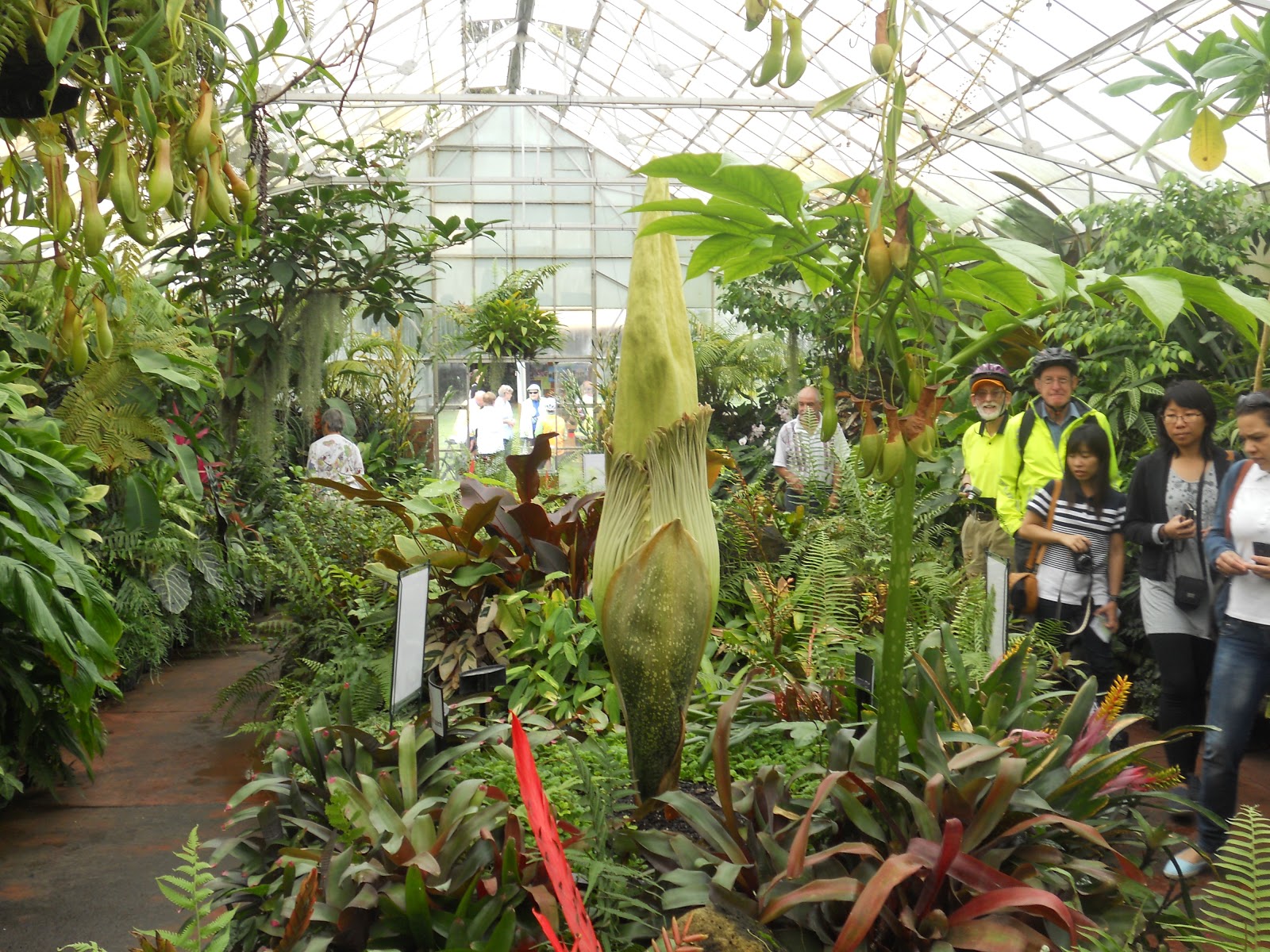
Below is the inflorescence in all its glory. It maxed out at 263 in height which breaks the Australian record and is also higher than the ones grown at the famous Kew gardens. For the record, yes the plant did smell quite foul.


The remnants of the line up. At this point they were turning people away as they were about to shut the hot house for the day. When I arrived the line was almost snaking all the way to the end of the roped off area.


Saturday, November 1, 2014

The Art of Botanical Illustration Exhibition 2014 including Beverley Lewis's 'Separation Tree' artwork.

Botanical Art Exhibition 2014


About a month ago I was contacted by the convener of the Friends of the Royal Botanic Gardens, Melbourne in relation to completing some writing to accompany some botanical art for an upcoming exhibition. I was quite excited about the prospect as writing an accompaniment for botanical artwork was a new prospect for me.

The artwork about which I wrote was an illustration of the 'Separation Tree' in the Royal Botanic Gardens, Melbourne. The artist is Beverley Lewis and the illustrations were done using graphite pencil. Seeing the art in person was amazing. Beverley emailed me some jpgs examples of the illustrations but I didn't realize how large (almost a 90cm high) and incredibly detailed they were until I saw them at the exhibition.  The Separation Tree tree has been the subject of some of my writing in the past and I've visited it on several occasions. I kept the writing to a few small paragraphs (see the finished product below). It is also interesting how the location of the exhibition mirrored certain details about he separation tree's history namely;
  • The Separation Tree is named so because Charles La Trobe made the proclamation of Victoria's split from NSW and the exhibition was next door to Charles La Trobe's cottage
  • The plaque under the Separtion Tree which briefly describes its history was unveiled by Sir Reginald Dallas Brooks and the exhibition was held in a building on Dallas Brooks drive.
In addition to Beverley's work there were 137 other spectacular pieces of art on display and all were for sale. They ranged from graphite pencil to pen and also watercolour. Another artist with work on display at the exhibition was Craig Lidgerwood. I've known Craig for a couple of years now as he lives Macedon which is my hometown. Seeing his two fabulous watercolour paintings was a suprise as I didn't realize he had anything featured.

If you are interested in botanical art I recommend you go see the exhibition. It closes on November the 9th and is open 10am - 4pm weekdays, 10am - 6pm weekends and 10am to 4pm on Sunday the 9th of November. The address is Dallas Brooks Drive, Melbourne.


Below are two jpg images of Beverley's artwork. These pale in comparison to seeing the real thing. The level of detail and size of the illustrations must be seen with the naked eye to be fully appreciated.


Below is my writing which accompanied Beverley's incredible artwork

_____________________________________________________________________________


On the morning of the 15th of November 1850, Charles La Trobe addressed a large gathering to formally announce that Victoria would become a colony separate from that of New South Wales. He made the famous proclamation at the north-western section of the Melboune Royal Botanic Gardens, under a River Red Gum tree. 

On that sunny spring day the newly established turf in the Botanic Gardens was an ideal location for a celebration. Perhaps this River Red Gum’s established size was a natural focal point for La Trobe to make his announcement or maybe it merely provided shade from the sun. Whatever the reason, this tree, through circumstances favourable to both location and time, made its way into the state of Victoria’s history and is now locally known as the ‘Separation Tree’.    

The Separation Tree is 24 metres high and its trunk has a diameter of 1 metre. It is estimated to be between 300 and 400 years old which means it predates European colonization. The site of the Royal Botanic Gardens in Melbourne was an important meeting and gathering place for the Wurundjeri people and other clans of the Kulin nation. As such the Separation Tree holds significance as a witness to Melbourne’s pre and post-colonial history.

           Alexander Krasovskis 

Royal Botanic Gardens Melbourne (undated) Aboriginal Resource Trail Teachers Kit, Royal Botanic Gardens Melbourne website.


Fagg, P (2012) ‘The ‘Separation Tree’: past present and possible future’ in The Victorian Naturalist, Vol 129 (4).

____________________________________________________________________________________________


The sign just outside the entrance to the exhibition with Charles La Trobe's cottage in the background


I visited the actual Separation Tree after the exhibition.


Links

Beverley Lewis's website 

http://bevlewis.zenfolio.com/ 

Exhibition website (whilst it is still up)

http://www.imis100ap1.com.au/FRBGM/FRBGM_Content/Botanic_Art_Folder/TABI/The_Art_of_Botanical_Illustration.aspx 

Craig Lidgerwood's website

http://www.craiglidgerwood.com/


Saturday, August 10, 2013

Revisiting the Titan Arum (Corpse Flower) in the Royal Botanic Gardens Melbourne

Last year just before Christmas I visited the Botanical Gardens in Melbourne in an attempt to see the flower of the Amorphophallus titanum plant (see my blog entry http://aggregata.blogspot.com.au/2012/12/visit-to-see-corpse-flower-aka-titan.html). Unfortunately I was 2 days too early and it hadn't opened yet. I left for holidays a day after I visited the plant and it opened when I was away. I was quite disappointed as I really wanted to experience the 'perfume' of the Titan arum's flower which is supposed to smell like rotting flesh (which is where it gets its other common name 'corpse flower' from). Anyway I revisited the tropical greenhouse at the Botanical Gardens and saw the amazing leaf which is what grows after the flower dies back. Although it looks like an actual tree the plant you see in the picture below is actually one single leaf. I'm pretty sure this is called a compound leaf but it could be called a phyllode which is a modified leaf structure, I'm not quite sure. Apparently the leaf dies back each year and is replaced by a new one which grows from the plants corm. Seeing the huge leaf almost made up for the fact that I missed the plant in bloom. Titan arums are quite rare plants and until recently they had only been propagated in small numbers. The gardens have others that are being grown so hopefully in the future I will be able to experience one in flower.


Front and centre is the massive single leaf structure of the Amorphophallus titanum plant. The individual 'leaves' you see are actually called leaflets. Another 50cms of growth and it will be too tall for the greenhouse.


Thought I would include these two pictures of some orchids that were in the greenhouse also. Everyone loves orchids and there were heaps in flower inside the greenhouse.


Thursday, August 1, 2013

The Royal Botanic Gardens in Melbourne Australia are under attack!

I visited the Royal Botanic Gardens Melbourne a couple of days ago and saw, amongst other things, damage that has been inflicted on trees and cacti by vandals. Probably the saddest sight was the Separation Tree which is a heritage tree that existed before Europeans colonized Australia.

The Separation Tree is named so because it is where citizens gathered to celebrate state of Victoria separating from the state of New South Wales in 1850. It also holds cultural significance for people indigenous to the area. It is a river redgum and is over 400 years old. The tree was ring barked back in 2010 and had survived by a technique called 'bridge grafting' where redgum sapling bark is grafted across the damaged area, thereby bridging the ring barking allowing energy photosynthesized by the leaves in the canopy to reach the tree's roots. Without the bridge grafts energy cannot be sent to the trees roots and they die. The dead roots cannot send water and nutrients up to the canopy and the canopy then dies. Needless to say it angers me and others to see it attacked once more as even with the bridge grafts the tree was still struggling to stay alive.

The most recent attack was on the 21st of July and amazingly it followed another attack which was on the area in the gardens known as 'Guilfoyle's Volcano' on July the 5th. Guilfoyles volcano is an area planted out with succulents and cacti. When I visited it the damaged plants were nearly all replaced but it didn't look quite as grand as many of the plants were smaller than the originals. Below is a link to a news report showing some of the scale of the damage to the cacti and succulents. In that attack most of the large plants in the succulent garden were damaged.

http://www.abc.net.au/news/2013-06-05/vandals-destroy-rare-cacti-in-royal-botanic-gardens/4735616

The attacks have prompted calls for better security to be installed to protect the gardens. The gardens CEO however, has stated  ''In the end though, the gardens can not, and should not, be a high-security compound" and also ''We seem to have a problem with a small number of individuals who have no regard for the importance of these trees and the significance of the gardens". If more attacks occur I personally think that tighter security is necessary and should be used.


The Separation Tree as I saw it on my visit. The hessian covers sphagnum moss in an effort to assist healing. I'm guessing that the moss is only a temporary measure and that bridge grafting will again take place.


Another victim, this time a spotted gum.


Sign of the times.


Attempted ring barking. I wonder whether they were disturbed and ran or if they just got tired and stopped?


This is the succulent garden that surrounds a water reservoir called 'Guilfoyle's Volcano' (not a real volcano of course).


The succulent garden was looking leaner than usual but impressive nonetheless.


More evidence of vandalism.


 'Guilfoyles Volcano' was built in 1876 to store water for the gardens. For 60 years it was left idle but has now been restored. William Guilfoyle become the second director of the Royal Botanic Gardens in Melbourne in 1873 succeeding Ferdinand Von Mueller. He radically changed the gardens and made them more ornamental and scenic as opposed to Von Mueller's vision which was more of a systems garden. Below are pictures of the top of the volcano. 


Thursday, December 20, 2012

Visit to see the Corpse flower aka Titan Arum or Amorphophallus titanum

Went to the Royal Botanic Gardens in the city today to see the plant known as Amorphophallus titanum. It goes by the common names of Corpse flower and Titan Arum. It got the name Corpse flower due to its scent which resembles a rotting carcass and it got the name Titan arum due to the fact that it can reach 6 metres in height.

This plant is native to Sumatra, Indonesia and is now considered vulnerable in the wild. Before 1987 this plant had only 21 flowering events recorded world wide. Since the 1990s this number has increased to 80. These low numbers are due to the scarcity of the plant and also the difficulty involved with nursing it to flowering maturity.

The plant itself can reach either 6 metres high or 3 metres high. This depends on luck, as the tuber it grows from will either produce a giant leaf (6 metres) or an inflorescence (cluster of flowers (3 metres if incredibly lucky)). The plant when mature produces orange / red berries. The rotting meat smell produced from the inflorescence helps with pollination. The smell attracts things such as flies, beetles and insects which pollinate the plants as opposed to pollination by bees.

As you can see from my pictures below the Titan arum that it isn't flowering yet. Once the flowers have bloomed they last only 2-3 days (which is also the only time you can smell its famous odour). According to staff it is due to flower on Christmas day or boxing day. Unfortunately I cannot visit it on either of those days but I plan to see it on Christmas eve so hopefully it will be open then. If not there are 5 other Titan arums being grown at the Botanic Gardens so I may be able to see one of those plants flowering some time in the future. The Ammorphophallus titanum can be found in the tropical greenhouse at the Royal Botanic Gardens Melbourne at the time of writing this blog entry.

Website below;
http://www.rbg.vic.gov.au/rbg-melbourne

I would approximate that this Titan arum was about 1.8 metres tall.


Seeing lots of other there to see this rare plant made me feel less tragic for having travelled 50 minutes to see it (well slightly less tragic).


This information plaque was full of, you guessed it, information!