Sunday, September 1, 2013

Bruno Torfs' art sculpture garden in Marysville Victoria Australia

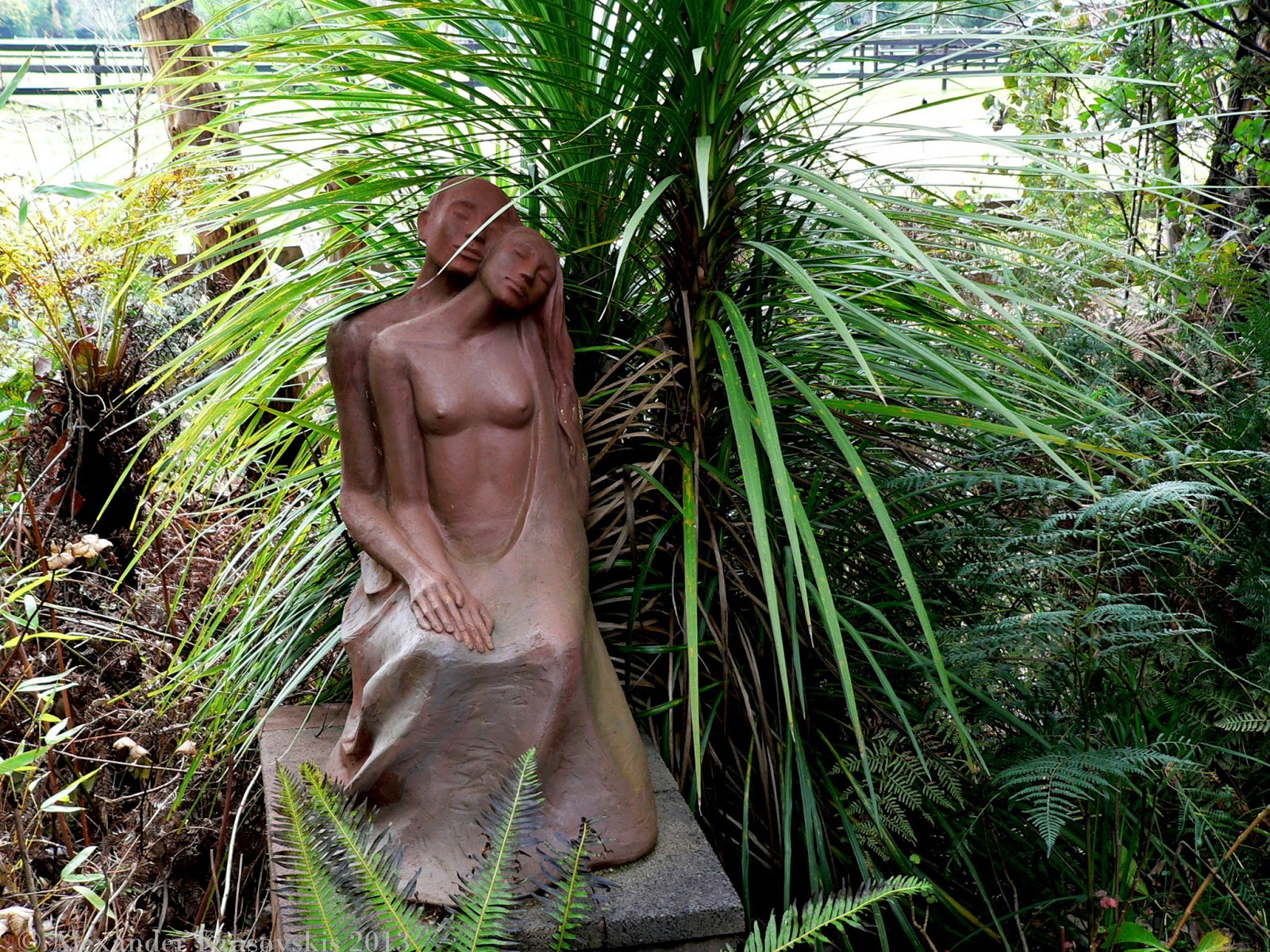
Clay sculptures in Bruno Torfs'  art garden in Marysville


Only my recent trip to Marysville I was left with half a day to fill and no plans. I browsed through the local tourist guide and came across information for an art sculpture garden created by an artist named Bruno Torfs. The tourist guide had only a few pictures and I wasn't expecting much but after my visit to the garden I was blown away by the quality and sheer number of sculptures in the garden.

The sculptures in the garden are all made from fired clay and were very detailed works. Most of the scultures are life sized but there are also several smaller pieces. They are positioned so they blend in with the trees and plants. They do not strictly follow one theme but obvious influences included fantasy characters, humour and also influence derived from Bruno's international travel.  The back of the garden has a running creek and when I visited the melting snows from the nearby mountains and ample recent rain meant it is flow flowing very fast. The river was my favourite part of the trip as it had several amazing sculptures including the 'Lady of Shallot'  sculpture complete with boat.

Asides from the sculptures the garden itself is something of an artwork. Although not strictly a native garden it had that kind of rambling native garden feel to it. The heroes of the plants in my opinion were the Hardenbergias (happy wanderers) which were climbing everywhere in the garden. Both the purple (violaceae) and the white (alba) were in flower and when they are blooming they are stunning. The garden was completely burnt through in the devastating 2009 fires. 40 sculptures were destroyed along with the plantlife (see this link for the aftermath http://www.brunosart.com/aftermath.html). Even so there seemed to be close to one hundred sculptures in the garden upon my arrival.

I highly recommend this garden if you are in the area. If you want more information on the garden and artwork you can see more on Bruno's website http://www.brunosart.com/




Monday, August 26, 2013

Visit to Marysville and Lake Mountain Australia

Lake Mountain bushland and Marysville town plantings 2013


Just got back from an overnight stay in Marysville after a day trip to Lake Mountain to see the snow. Marysville is a town 99km out of Melbourne which, along with several other old Victorian rural towns, was established as stopping point between Melbourne and the goldfields (in this case the upper Goulburn goldfields). It also attracted loggers as it is still surrounded by massive Mountain Ash trees which were once touted as Australia's tallest trees. In 2009 the destructive 'Black Saturday' bushfires ripped through the town causing massive damage. 90% of Marysville's buildings were destroyed and 45 people died in the fires. I visited in 2010 and the town was still badly damaged. I remember seeing that the shops on the main street were destroyed and were temporarily operating out of shipping containers. There was also burnt buildings and trees everywhere. It was a great pleasure this time, to see the town basically fully rebuild and with all services up and running. The great thing was that such a great job had been done during the rebuilding process. The main streets buildings were all up and running and the streetscape planting was magnificent. The main street was lined with hellebores, grape hyacinth and daffodils. Also a new park named 'Gallipoli Park' was build with state of the art planting (a mixture of Australian natives and exotics) and play equipment. The visit to Lake Mountain was both shocking and beautiful. The mountainside was full of ghostly dead snow gums that were also destroyed in the bushfires. As sad as it was to see them in that state they did look striking with the fog drifting through them. The other pleasing thing to see was all the new growth  starting to rise up from the ground level which was once shaded out by the canopy that was lost to the fires.


Several pictures below of Lake Mountain's dead snow gums and new growth appearing over snow.


This is a man made river bed near the new 'Gallipoli Park'. I wish I took some pictures of the park itself. The seeing the park's native plant scheme has reinvigorated my interest in the use of native plants for ornamental purposes. 


The next 3 pictures are of street side plantings on the main street of Marysville. They are all good choices in my opinion. The bulbs should do well because of the cooler climate and hopefully the hellebores should thrive under the deciduous oak trees that shade them in summer.


Saturday, August 24, 2013

How to plant and care for Hellebores

Hellebore growing guide

As lovely as Hellebores are they are not the easiest plant to grow. I recently bought some myself and was given a growing guide with them. The following information is from both the growing guide and my own personal experience with these plants.


The correct climate and planting location for Hellebores in Australia

In Australia Hellebores can be grown in Victoria and Tasmania. They will grow as far north as Sydney but they are ideally suited to the colder weather of the Southern states. As you may have guessed these plants are not effected whatsoever by frosts. Hellebores do not like sandy soil or waterlogged heavy clay soils so something in between is needed. The planting position of Hellebores is important. They need to be shaded in summer and have as much sun as possible in winter. This is why people always tell you to plant them under deciduous trees.

Planting Hellebores

Hellebores have very fast growing root systems so you need to plant the as soon as possible. They put on most of their growth in winter so planting them as early as possible in the cool seasons gives them more of a chance to establish themselves. Plant them about 60cm apart and loosen the roots before planting. Incorporate organic matter into the soil before planting and water in afterwards.

Hellebore maintenance

When new growth starts to show through in late autumn remove all old growth. Late autumn is also time to feed these plants as the main growth occurs in winter. During the warm months inspect the plants for aphids. Hellebores usually need 2 to 3 years to establish before flowering will occur.

Conclusion

If you follow these instructions your Hellebores should thrive. The main point is the planting location. They really do need as much sun as possible in winter to put on a good show of flowers. Some people have told me that they need full sun but in my experience I have seen Hellebores flowering well in locations with an eastern aspect so they would only be getting full sun for half a day. Good luck!


Saturday, August 17, 2013

Euphorbia characias subsp. wulfenii. An extremely tough and drought tolerant plant for Australian conditions.

Whoever owned my house before I bought it decided to put a garden bed right under the eaves outside my bedroom. This is a bit of a classic mistake as the cover of the eaves provides a rain shadow. Essentially no rain will fall on the portion of the garden bed under the eaves creating desert like conditions. I tried planting plants there and watering them with my trusty watering can but I would inevitably let the area dry out too much and they would die. Then somebody recommended that I try planting Euphorbia characias subsp. wulfenii there and I haven't looked back. The Euphorbia genus may be more well known as a weed to some (and this particular plant is restricted in W.A and the N.T)  rather than an ornamental plant but that weedy robustness is what makes the charcias species such a great plant. The soil under my eaves where this plant is growing is really sandy and dry. I do still water this plant but only once every couple of weeks and it would only get 10 litres at a time if it is lucky. Despite that lack of water and poor soil it has thrived and I would highly recommend it as a drought hardy perennial plant for people in Melbourne or even up in the central highlands of Victoria. It is said that it needs full sun but mine is planted on a Western aspect so it can deal with part shade. Although it is said to be a perennial it does get quite leggy after a few years but I have found that it self seeds quite well so there is always some new plants on the rise. Euphorbia characias is native to the Mediterranean and its milky latex sap has been used as an ancient traditional plant medicine to treat skin issues such as warts, skin cancers and tumors. The latex sap however is to be treated with caution. If you get it in your eyes it can cause significant damage. Do not ingest any part of this plant as it is toxic. There are several different cultivars that are in nurseries so if you are in the market for a low maintenance, drought tolerant plant (and don't live in W.A or N.T) then give it a go.


A close up (and slightly out of focus) shot of the flowers.


Euphorbia characias in full bloom during winter.


I find the foliage of Euphorbia characias more interesting than its flowers. The 'Black Pearl' cultivar has foliage the same shape as the one pictured below but with dark and almost black leaves.