Showing posts with label Winter flowering plant. Show all posts

Wednesday, September 24, 2014

Add some blue to your late winter / early spring garden with Spanish bluebells

Hyacinthoides hispanica (Spanish bluebells)

Around this time of the year a nearby town called Kyneton hosts a daffodil festival. The cooler climate that the area provides really suits daffodils and as such lots of people have them growing in their gardens. That being the case another bulbous plant commonly known as the bluebell has to take a back seat to the Narcissus plants.  It flowers at the same time as daffodils and jonquils and planted in mass is quite spectacular.

Hyacinthoides hispanica or Spanish bluebells are native to an area known as the Iberian Peninsula which as expected contains the Spanish coastline and other nearby regions. They are dead easy to grow and as with many other bulbs they are extremely hardy specimens. I have seen them growing in extremely dry locations such as under an archway where almost no rain would fall. In England they have hybridized with Hycacinthoides non-scripta and the resulting plant is quite invasive. In Melbourne this isn't the case and they are a great addition to your other bulbous plants.

After they finish up for the year let them die back and try to resist cutting back the browning foliage. If you leave the foliage to die back the bulbs will benefit and draw energy from the leaves. This energy will assist in the next years bloom. If left in place they will naturally propagate themselves and you should get more and more each year. If you get too many simply dig up some of the unwanted bulbs.


Saturday, September 13, 2014

Funeral flower, calla lily or death lily. Zantedeschia aethiopica. Weed plant or ornamental plant?

Old school ornamental garden plant Zantedeschia aethiopica

Zentedeschia aethiopica is a really classic plant that is found in many gardens in Melbourne Australia. It is one I associate with the 60s because it seems to be in lots of gardens that look like they were planted out in that era. Often when I look in the established gardens of old orange brick houses or Californian bungalows they seem to have a clump of these somewhere. Often they are amongst all the other old style plants that are no longer used in todays planting, things such as the red berried Catoniasta or mirror bush (Coprosma repens). I clearly remember clumps of funeral flowers growing in my Grandparents house so maybe that's also why I think of it as an old school plant. It is native to regions in southern Africa, has a height of potentially 1m and a clump may potentially spread to approximately also 1m. It is well known for its large white flowers consisting of a white spathe surrounding a yellow spadix.

Is the yellow spadix of Zantedeschia aethiopica poisonous? 

The short answer is yes. However according to information I've read on the Kew gardens website the whole plant is poisonous not just the spadix. Eating this plant can cause irritation, swelling of the mouth and acute diarrhoea. Not my idea of a good time.   

Common names for Zantedeschia aethiopica

The other gardeners I speak to today almost exclusively give this plant the rather plain moniker of arum lily. It has many common names, the most popular of which seem to be funeral flower, trumpet lily, calla lily and death lily. Funnily enough my own mother had funeral flowers at her wedding (I'm not sure if she knew of the flowers name).

A plant so hardy that it considered a weed in some parts of Australia

Yes it is considered a weed as it thrives along creek lines and wet areas in Western and South Australia. I was once told that it is comparable to Agapanthus orientalis in terms of it being an almost 'unkillable' plant in Victoria. It is a clump forming perennial which has underground rhizomes that it uses as an energy store to re shoot in the cooler months after dying down during the warm season. Propagation is incredibly easy as it is just a matter of dividing the rhizomes with a spade and replanting them.


Close up of the classic white spathe and yellow spadix.


A clump of Zantedeschia with a couple of flowers on display.


Saturday, August 24, 2013

How to plant and care for Hellebores

Hellebore growing guide

As lovely as Hellebores are they are not the easiest plant to grow. I recently bought some myself and was given a growing guide with them. The following information is from both the growing guide and my own personal experience with these plants.


The correct climate and planting location for Hellebores in Australia

In Australia Hellebores can be grown in Victoria and Tasmania. They will grow as far north as Sydney but they are ideally suited to the colder weather of the Southern states. As you may have guessed these plants are not effected whatsoever by frosts. Hellebores do not like sandy soil or waterlogged heavy clay soils so something in between is needed. The planting position of Hellebores is important. They need to be shaded in summer and have as much sun as possible in winter. This is why people always tell you to plant them under deciduous trees.

Planting Hellebores

Hellebores have very fast growing root systems so you need to plant the as soon as possible. They put on most of their growth in winter so planting them as early as possible in the cool seasons gives them more of a chance to establish themselves. Plant them about 60cm apart and loosen the roots before planting. Incorporate organic matter into the soil before planting and water in afterwards.

Hellebore maintenance

When new growth starts to show through in late autumn remove all old growth. Late autumn is also time to feed these plants as the main growth occurs in winter. During the warm months inspect the plants for aphids. Hellebores usually need 2 to 3 years to establish before flowering will occur.

Conclusion

If you follow these instructions your Hellebores should thrive. The main point is the planting location. They really do need as much sun as possible in winter to put on a good show of flowers. Some people have told me that they need full sun but in my experience I have seen Hellebores flowering well in locations with an eastern aspect so they would only be getting full sun for half a day. Good luck!


Saturday, August 17, 2013

Euphorbia characias subsp. wulfenii. An extremely tough and drought tolerant plant for Australian conditions.

Whoever owned my house before I bought it decided to put a garden bed right under the eaves outside my bedroom. This is a bit of a classic mistake as the cover of the eaves provides a rain shadow. Essentially no rain will fall on the portion of the garden bed under the eaves creating desert like conditions. I tried planting plants there and watering them with my trusty watering can but I would inevitably let the area dry out too much and they would die. Then somebody recommended that I try planting Euphorbia characias subsp. wulfenii there and I haven't looked back. The Euphorbia genus may be more well known as a weed to some (and this particular plant is restricted in W.A and the N.T)  rather than an ornamental plant but that weedy robustness is what makes the charcias species such a great plant. The soil under my eaves where this plant is growing is really sandy and dry. I do still water this plant but only once every couple of weeks and it would only get 10 litres at a time if it is lucky. Despite that lack of water and poor soil it has thrived and I would highly recommend it as a drought hardy perennial plant for people in Melbourne or even up in the central highlands of Victoria. It is said that it needs full sun but mine is planted on a Western aspect so it can deal with part shade. Although it is said to be a perennial it does get quite leggy after a few years but I have found that it self seeds quite well so there is always some new plants on the rise. Euphorbia characias is native to the Mediterranean and its milky latex sap has been used as an ancient traditional plant medicine to treat skin issues such as warts, skin cancers and tumors. The latex sap however is to be treated with caution. If you get it in your eyes it can cause significant damage. Do not ingest any part of this plant as it is toxic. There are several different cultivars that are in nurseries so if you are in the market for a low maintenance, drought tolerant plant (and don't live in W.A or N.T) then give it a go.


A close up (and slightly out of focus) shot of the flowers.


Euphorbia characias in full bloom during winter.


I find the foliage of Euphorbia characias more interesting than its flowers. The 'Black Pearl' cultivar has foliage the same shape as the one pictured below but with dark and almost black leaves. 


Tuesday, August 6, 2013

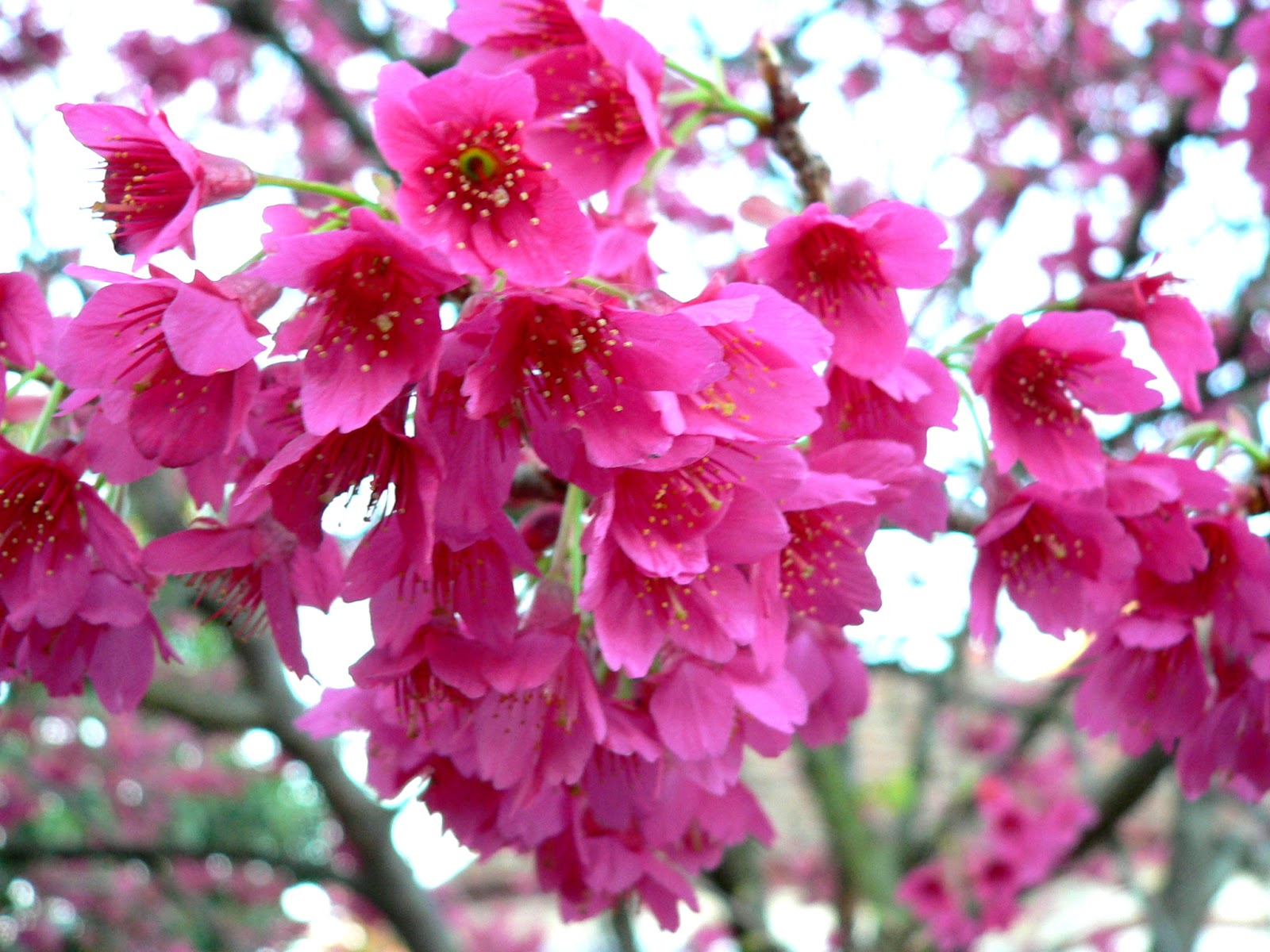
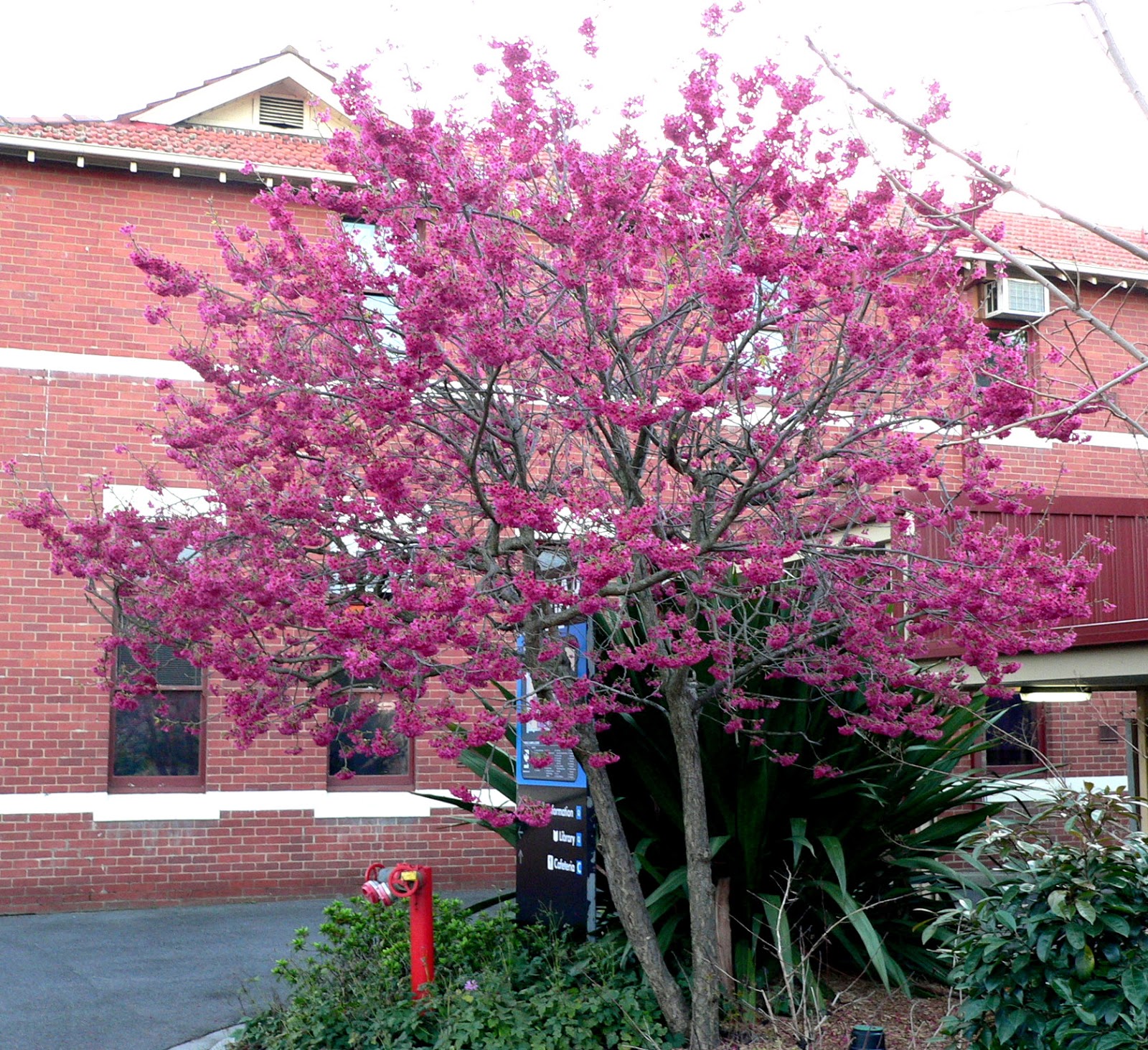
Winter flowering tree Taiwan Cherry (Prunus campanulata)

At the NMIT Fairfield campus where I study Horticulture there is a sad looking row of Taiwan Cherry trees. Sad because the have had some bad pruning done on them but at the end of the row is the beautiful tree you see in the pictures below. Prunus campanulata is a tree native to China and Japan. According to information I've seen on the good old internet it can grow to 7m high with a spread of 7m however I can't say I've ever seen one grow to that size. Maybe in Melbourne they don't quite have the ideal conditions they require for full growth or maybe I've just been unlucky and walked past a huge specimen without looking. This beautiful tree is actually an environmental weed in New Zealand where it has spread throughout several parts of the country. Cultural notes on this tree seem to be basically the standard (ie rich and well drained soil with moist conditions) but the fact that it has escaped as a weed in New Zealand seems to suggest that it is not too fussy about its habitat. In all the cultural  notes I've found it is stated that it will grow in clay, loam or sandy soil and it also like full sun. I think that this tree would look great in conjunction with some traditional Cherry Blossom trees as it flowers at the same time.


Prunus campanulata flowers in bloom


The tree in it's entirety and in full bloom.


Close up of the flowers.


Friday, July 19, 2013

Winter flowering plants in Parkville

It's a common misconception that plants do not flower in winter. In Melbourne this is definitely not the case and I am a great believer in winter flowering plants they provide attractive colour  in the garden when the deciduous trees have lost their leaves. Although we are now approaching the middle of winter there are lots of beautiful plants in bloom at my work. Strangely the weather has been unseasonably warm lately with several days approaching 20 Celsius after frosty mornings. The warmer temperature makes gardening a lot more comfortably and to be honest I haven't hated the frosty mornings because, in Parkville, I have had lots of physical morning tasks that keep me warm. Of all the winter flowering plants my favorite has to be the Magnolia trees. There is one large specimen in Parkville that, so far, has not lost its buds to hungry possums. Last year it only had a handful of flowers due to bud loss but its looks as though it will fully flower this year.


Magnolia soulangiana. This could be my favorite tree and the flowers are just starting to pop.


The same tree as above. You can see how many flowers have already opened. This time last year we only had about half of what is shown here across the whole tree. Notice the sunny blue winter sky.


Hellebores are also starting to open. We have several different types in the Parkville garden.


Another Hellebore. Not sure of the variety but I'm fairly sure we sourced them from 'post office farm nursery' which is a grower up in Woodend near my home. They have open days on Sundays this time of the year. A link to their website is below.


The annual bed is loaded with new plants. I planted Kale, Violas, Pansies, Cinerarias and Stocks. I also cannot bring myself to remove that small bunch of violets that have self seeded in the front of the bed. In a mont or so this bed should look fantastic.


I discovered this plant in flower whilst pruning some nearby Wisteria. It is called Luculia and its perfume smells amazing. 


The good old Salvia plant keeps flowering year round not just in winter.


Several bulbs have popped up out of the ground and this Jonquil seems to have beaten them all and flowering first.


Below is a Strelitzia or 'bird of paradise'. These plants are a common sight in many Melbourne gardens. They are tough plants which do not need much water.


Another one of my favs is the Kniphofia plant pictured below. The ones I propagated and planted at home have still not flowered but the ones in Parkville are in full bloom.


Wednesday, May 22, 2013

Euryops pectinatus or the Yellow daisy bush. A classic plant for adding colour to your garden in winter.

In winter the most showy plant I have in my garden in terms of masses of colourful plants is my Euryops pectinatus. Euryops are a classic perennial plant that can be found in many Australian gardens. It has some degree of frost tolerance and tolerates a certain amount of dryness. This perennial is native to South and Central Africa and the name Euryops comes from the Greek Eurys (large) and ops (eye). There are several different varieties of Euryops but I would say that most can grow to about 1.7 high and 1.7 metres wide. I cut mine back after flowering but I let it go for a couple of years and it has gone a bit leggy. I have read that they strike quite easily from cuttings so I will try and propagate some that way and start them off again. It has a silvery sheen to its foliage which some say combines well with Wormwood which has a similar leaf. Here in Australia this plant is probably considered boring by some because it is extremely common but I love it as its is fairly low maintenance and provides some vivid colour to my garden in the cooler months. Among the common names for Euryops pectinatus are Yellow daisy bush or Golden daisy bush.


The classic daisy (asteraceae) shaped flower of my Euryops growing in Macedon Victoria.


Look at all those flowers. You would be forgiven for thinking that it is Spring.