Tuesday, May 6, 2014

Visit to Stephen Ryan's amazing garden 'Tugurium' in Macedon, Victoria, Australia

Open garden 'Tugurium' in Macedon


Last Easter weekend I had the pleasure of manning the gate at Stephen Ryan's home garden in Macedon. Stephen is well known in horticulture circles throughout Australia and is particularly well known amongst plant and garden buffs in his home town. He has amazing plant knowledge and is the president of the Macedon horticultural society.

I first met Stephen almost 4 years ago when I visited his nursery on Mt Macedon. I spoke to him about wanting a career in horticulture and was lucky as he recommended me for a job and thus my life as a gardener began in proper. He has a passion for collecting plants and runs a rare plants nursery. He has GPCAA (plant trust) collections of the genus cornus, acanthus and sambucus. He was the previous host of the popular Australian television show 'Gardening Australia' and is also an all round nice guy.

His garden is called 'Tugurium' which is latin for hovel or basic dwelling. My fellow gate minder on the open day told me Stephen humorously named it so after hearing somebody rudely remark that his property (when it was first purchased and essentially a vacant block of land with a small house) looked like a hovel. The property in its original state had virtually no topsoil. All the topsoil there now is the result of organic matter being dug in. Spent potting mix from Stephen's nursery is also regularly added to the topsoil and garden beds. The garden is basically a garden which has an amazing amount of different plants in it with a narrow paths that meanders throughout. There is a veggie patch, chook house and pond area. The garden is so full of plants that walking along the narrow path creates the sense of several walled garden areas as you cannot see the garden in its entirety only what is in your present space. The front of the garden is a bit more open and has several established trees and big manna gum that was planted to provide a home and food for the local Koalas.

There is lots to see in this garden I would definitely recommend a visit next open day. The sheer number and variety of plants that are jammed in this property is staggering and the garden path walk is an experience to remember.

Link to Stephen's website below
http://stephenryan.com.au/


Medlar tree with fruit in the front of the garden


Abutilon plant. An oldie but a goody.


One of many garden beds in the front of the garden. A good example of how many plants are incorporated into the garden. Not sure of all of their names but I can spot Rhus trees and Miscanthus grasses.


This timber walkway forms part of the garden path that winds through the garden.


More of the path with the popular Dicksonia antartica (common name soft tree fern). Tree ferns thrive up in Macedon where the weather is a bit cooler than Melbourne.


I think Stephen's plant collecting is getting out of control. This sun dial was engulfed by so many plants that I'm pretty sure that no direct sun would ever strike its face. I could be wrong it was an overcast day.


Wow what a great looking pond area. I think the downfall of many ponds that people place in their gardens is that they look too manufactured whereas this one has a nice natural appearance.


Chicken coop and run. This one is nicknamed 'Cluckingham palace'.


A view of a portion of the garden path. You can see here how the garden creates the effect of walking into several walled gardens due to the sheer number of plants and clever placement of gates and archways. 


Another section of the garden towards the rear of the property. Amaranth plants and a small section of the veggie garden. 


Tuesday, April 22, 2014

French lavender is a great choice for an ornamental or hedging plant

French lavender (Lavandula dentata)

Lavender is in my opinion one of the most classic ornamental plants. Almost everyone you ask knows what lavender looks like and also knows its perfume. There are several types of lavender, the most well known of which are English lavender (Lavandula angustifolia) and French lavender (Lavandula dentata). Both these species are commonplace in many Australian gardens but my favourite is French lavender.

Background information on French lavender

French lavender is native to the Mediterranean, Atlantic islands and Arabian peninsula. It's used for ornamental purposes and also for its essential oils. French lavender likes to grow in dry conditions with full sun. Apparently it also likes alkaline soil but it seems to grow fine in the slightly acidic soils that I have at home. You may also read that it doesn't tolerate frosts but it is fine in my garden in Macedon where we get significantly heavier and more frequent frosts compared to Melbourne. This leads me to believe the frosts people are referring to when stating that frost can be a problem for French lavender are the really biting European frosts. The species name dentata means toothed and refers to French lavender's toothed shaped leaflets. I love the perfume of lavender and can personally attest to it being a relaxing and calming effect. Whenever I spend the day pruning lavender hedges I always feel really relaxed when I get home later that day. Some people make small lavender packages they place in their pillows to help them sleep.

Why do I prefer French over English lavender?

I personally prefer the appearance of French lavender as it is more green than its greyer English counterpart. I also like the fluffy foliage as opposed to the more needle like foliage on English lavender. French lavender also has a much longer length of bloom so you will see flowers on it for a good portion of the year. Because French lavender is less woody than English I suppose it is also easier to strike from cuttings also both plants respond well to this form of propagation. One of the real benefits of French over English lavender is its ability to grow back from a really hard pruning.  French lavender hedges can be pruned back almost all the way to the wood but English lavender doesn't react well to really hard pruning and if you go all the way back to the wood you can potentially lose the plant.

Personal preference

The choice of an ornamental plant can be compared to the choice of a painting on a wall. So long as the growing conditions are suitable the choice is one of personal preference. English lavender fans may read this and completely disagree with me and that is fine as many of the reasons I have listed in the above paragraph are purely aesthetic. Many people prefer the look of English lavender because to them it the more traditional looking species. Each to their own.


Close up of the magnificent lavender flower. These are on display for a good portion of the year in my home garden.


My small French lavender bush in my Macedon garden during early autumn. Notice the massive amount of flowers it has in bloom. This plant holds some sentimental value for me as it is the first plant I propagated and grew into a full sized specimen. 


Saturday, April 5, 2014

Visiting the Forest Glade Gardens on Mount Macedon in summer

Forest Glade Gardens in summer 2014


Towards the end of last summer I took some visitors from England up to Mount Macedon to view a garden. I remember looking on the open gardens website and seeing that nothing was on offer up there on that particular weekend. That being the case I knew that there are always a few gardens that are open for viewing as these particular ones are open every weekend. We decided to visit Forest Glade. I didn't know anything about Forest Glade and for some stupid reason thought that because the garden was open all the time and not part of the open garden scheme openings that it would be a bit sub standard. How wrong I was. Forest Glade is a huge garden (14 acres) and has 4 different areas. Those areas are an English garden, a woodland garden, a Japanese garden and a cool fern gully. The gardens were very well maintained and unbelievably green considering I was there in the middle of a really hot spell (I'm pretty sure this was only a week after we had that run of 40+ Celsius days). The gardens also have lots of sculptures placed here and there. One of the great things about living in Macedon how the trees colour up so vibrantly during Autumn so I'm definitely going back there in a few weeks.


This is the first view you experience upon entering the gardens. Believe me the shade was a godsend on the 30+ Celsius day I was there.


I love these pavilions (there must be a more accurate word for them). 


One of many sculptures throughout the gardens. This one is near the front.


Top view of the topiary area.


Arum lillies growing in a cascading water feature at the top of the topiary garden. 


So much box hedge. These big gardens on the Mountains are full of hedging.


Topiary swan


Bear and giraffe all neatly clipped


The next 4 pictures are of spectacular dahlias that were growing in a herbaceous bed. They are such showy flowers. I really need to get some for my garden at home.


The remainder of the photographs are of the Japanese garden. This really was an impressive part of the gardens. Its probably has to be the largest section of Japanese garden I have seen in Victoria to this day.


Wow look at that circular passageway.


Pond area complete with stepping stones and massive goldfish.


This small path was really cute. It wasn't anywhere near big enough for any person to walk though. I'm guessing it was a water feature as it runs into the pond area.


Bonsai house.


Saturday, March 29, 2014

Melbourne International Flower & Garden Show 2014 review

Today I made my annual journey to the Carlton gardens for every Melbourne plant and garden nerds favorite show MIFGS (pronounces miff-guss by those in the inner circle) aka the Melbourne International Flower and Garden Show. The weather was overcast in the morning but the sun broke through the clouds with impeccable timing, beaming onto the exhibits and show gardens as soon as I left the main building to wander outside. I'm not sure what the overall head count was but the show was packed with more visitors than I have ever seen. I heard that there were record numbers visiting on the first day so it looks as though gardening is well and truly booming in the city of Melbourne (which is interesting considering the rather savage weather Melbournites have endured this summer). As usual I bought a few packets of bulbs. For the record this year I purchased Oriental liliums,  drumstick alliums, peacock flowers and a single Ferraria crispa to compliment my Ferraria undulata. Because of the sheer numbers there it was difficult to get good photographs without waiting for ages for people to clear out of shot. Nevertheless I took quite a few. If you are reading this the night I have posted it then tomorrow is your last chance to see the show before it packs up for the year. Get down there and have a look.


Interflora was the major sponsor of the flower section. Just like last year they didn't fail to impress with their display.


I took several shots of the flowering arrangements done by my fellow students at NMIT. The floristry students are in the same building as the horticulture students and as such I see them working away during the year.  This first shot is an arrangement by Alena Matthews. At first it seemed very morbid but it is actually representing the Mexican 'day of the dead' festival.


 Leyla Ismail from NMIT did this this lovely display.


Margaret Mclennan from NMIT took out 3rd place with the arrangement below. The sun was really streaming in with intensity from behind the arrangement making it difficult to get a good shot.


Bianca Besanco from NMIT secured 2nd place with this arrangement.


Finally Susie Dimitra Portelli from Marjorie Milner College won first with the arrangement below. Damn it NMIT bought home the silver and bronze but missed out on the gold.


Ever since I obtained my first David Austin last year I've become a real fanboy of Mr A's roses. The new rose they were showcasing there was called 'Princess Anne'. Of course I had a whiff and of course the perfume was amazing.


Another company that always puts on a great display at any MIFGS is Tesselaars. The sun lit up these jonquils just at the right time.


Everyone loves Hyacinths.


Tesselaars are most well known for their tulips. I love the ones to the right. They are called 'Monet talent'.


Speaking of Monet you can see why he painted tulips. The only editing I did on the picture below was bumping up the light levels a smidgen along with bit of cropping. The more I look at the photograph I took below the more it looks like a painting (especially the red tulips at the front). 


 Sean Diamond created this steel eagle.


Alistair Mason created the sculpture below named 'Chook Chaser'. It is made from reclaimed steel.


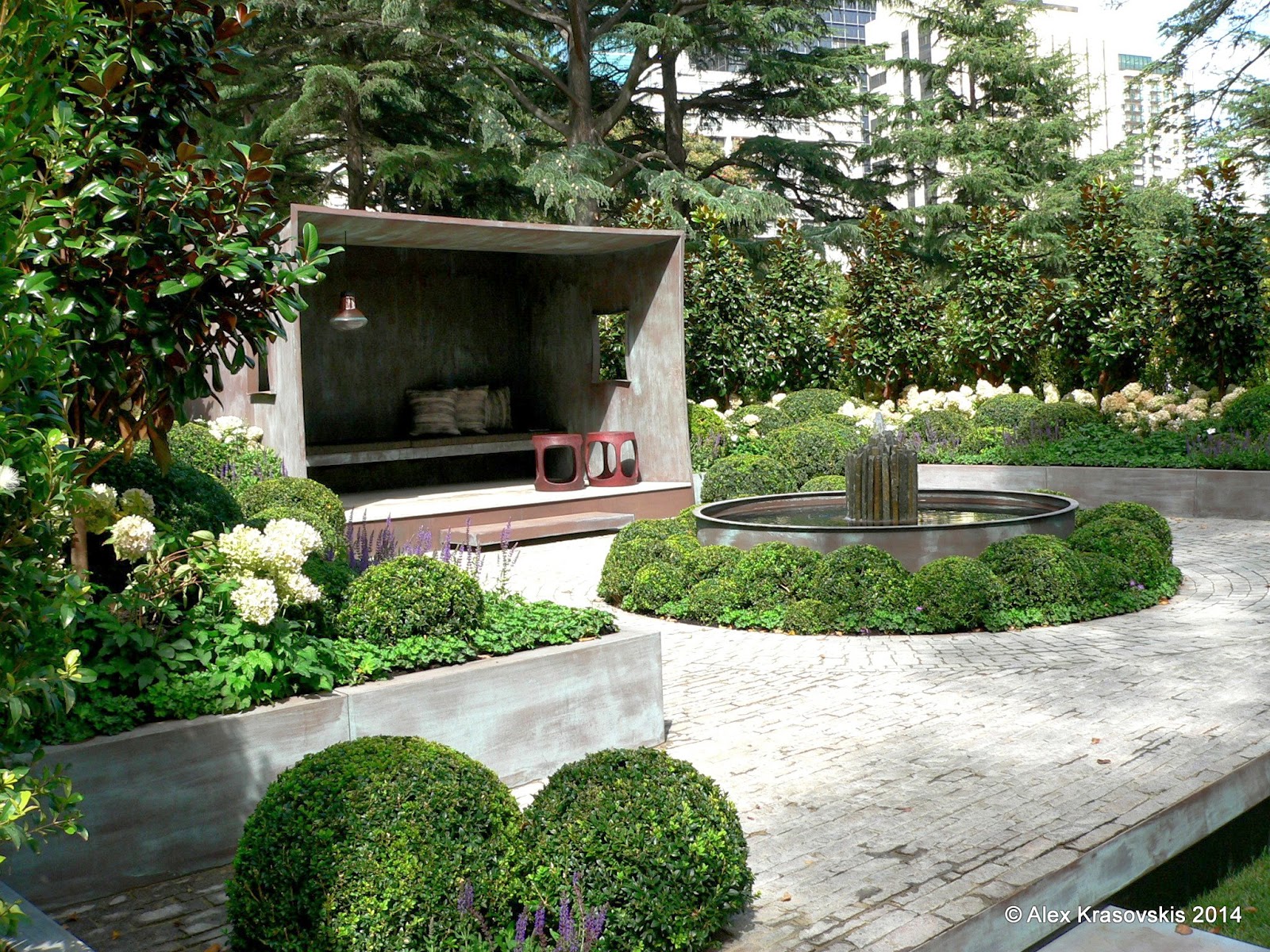
'The midnight garden' was designed by Lisa Ellis gardens. It took out first place in the boutique gardens section.


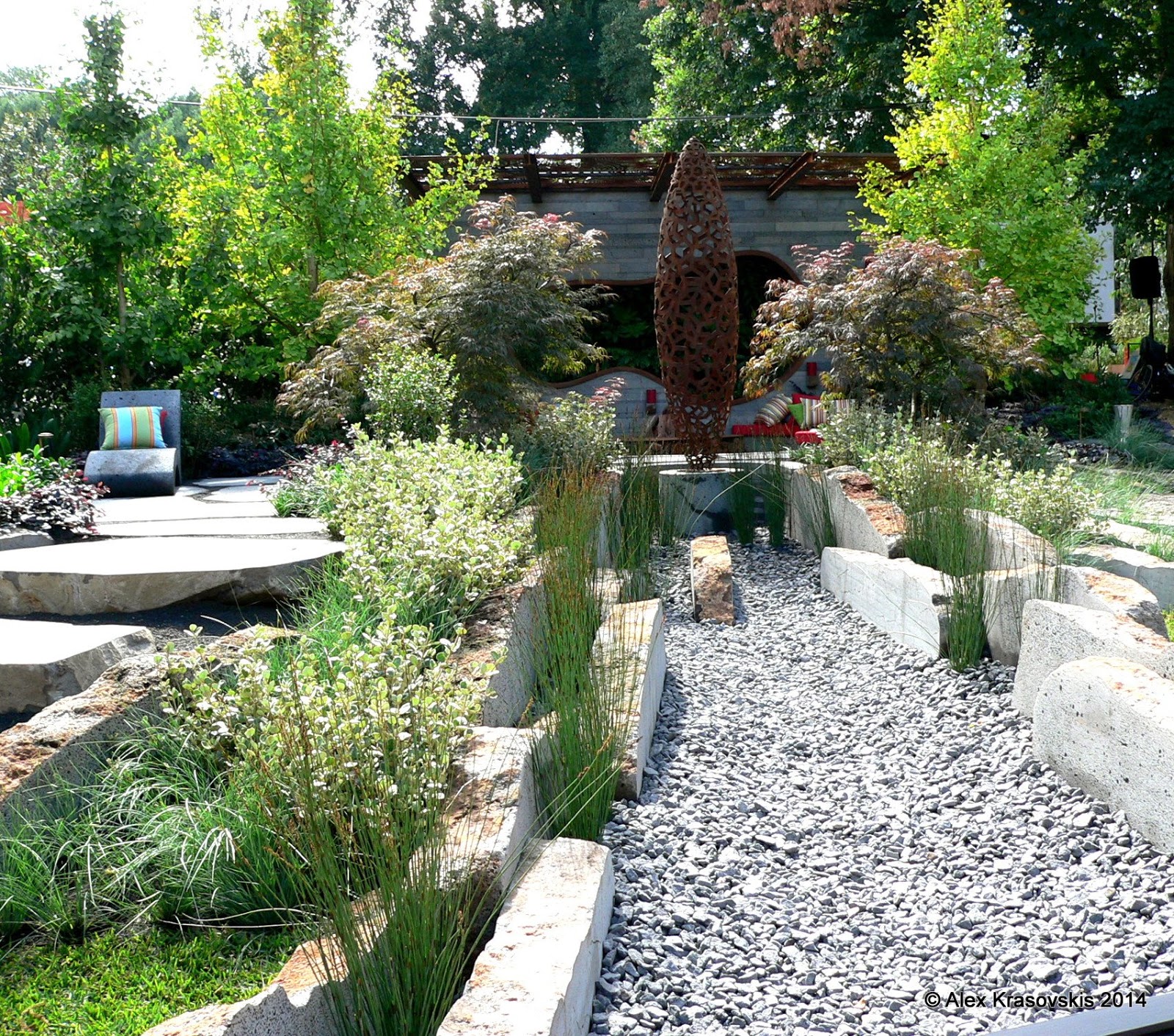
The next four pictures are of the 'Patriarch garden' by Cycas Landscape Design. It took out the gold medal and overall best in show awards. Yes it was stunning and in my opinion deserved to win. Aside from the plants I loved the paving and steps they incorporated. There was lots of natural stone in this design.


This next shot is of the design called 'Here & Now' by Phillip Withers. It won the sustainability award.


One of the big draw cards for this years show was a design by uber designer Paul Bangay. When I saw the design at the show I liked it but I wasn't over impressed. Then when I got home and looked at the photographs I snapped I seemed to like it even more. It a really well layered design and being a Paul Bangay design it incorporates a bit of topiary. Paul named this design 'Tension'.


 The next two shots are of a design called 'The Muse' by Natural Design. I love that sculpture in the foreground.


 This next design is called 'Vanguard' by Hunter Black Designs. It took out the bronze medal.


The picture below is a design called 'Left-overs' by Ian Barker Landscapes. It featured an old shipping container as an outdoor living space.


This design is called 'A gardeners garden' by Emma Tenni and Thomas Pinney of NMIT. It took out third place in the achievable gardens category. This category showcases up and coming talent as all designs are by horticulture students.


 Below is a design called 'Edible space' by Scott Tappenden and Melissa Greenslade of NMIT. It wond second place in the achievable gardens section.


And first place went to.............  Kingsley A Barker from Holmesglen TAFE! Incredible just as in the flower arranging  my fellow NMIT students take out 2nd and 3rd but miss out on 1st place.


Last of all I'm going to finish off with these humungous corten steel birds Folko Kooper and Maureen Craig. Impressive they are but maybe a little bit too large for my garden at home.